 How Much Does Lawn Care Cost in Denver, CO? (2026)


How Much Does Lawn Care Cost in Charlotte, NC
by Gene Caballero | July 09, 2026
How Much Does Lawn Care Cost in Charlotte, NC? (2026)
Quick answer. Most Charlotte homeowners pay $40 to $50 per visit for a standard suburban lawn in 2026, covering mowing, trimming, edging, and blowing.
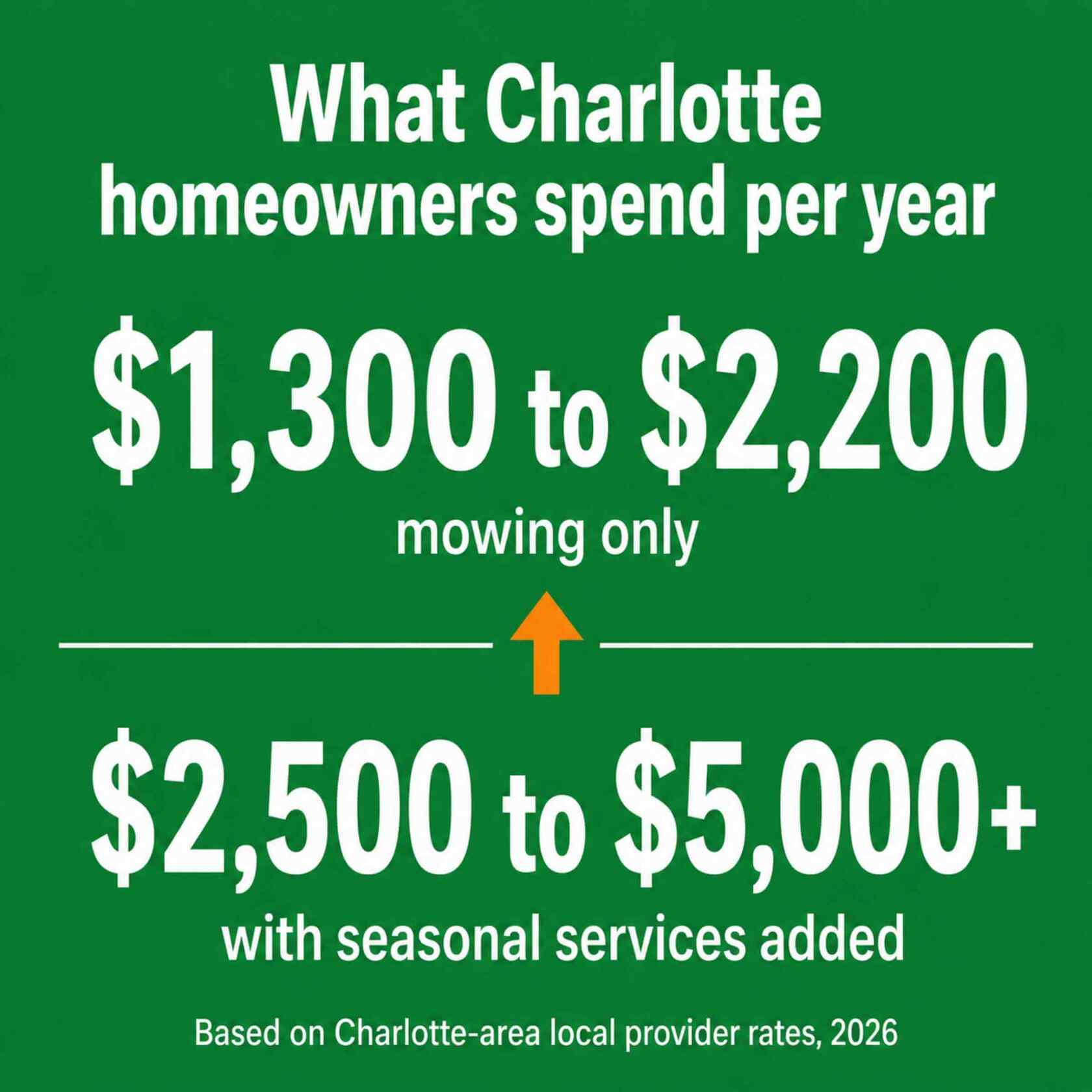
Your yearly total depends on grass and frequency. Mowing alone runs roughly $1,300 to $2,200 a year, climbing to $2,500 to $5,000 or more once seasonal services are added.
Competing quotes are how you land a fair rate. On GreenPal, you can collect bids from several vetted local Charlotte pros and pick on price and rating.
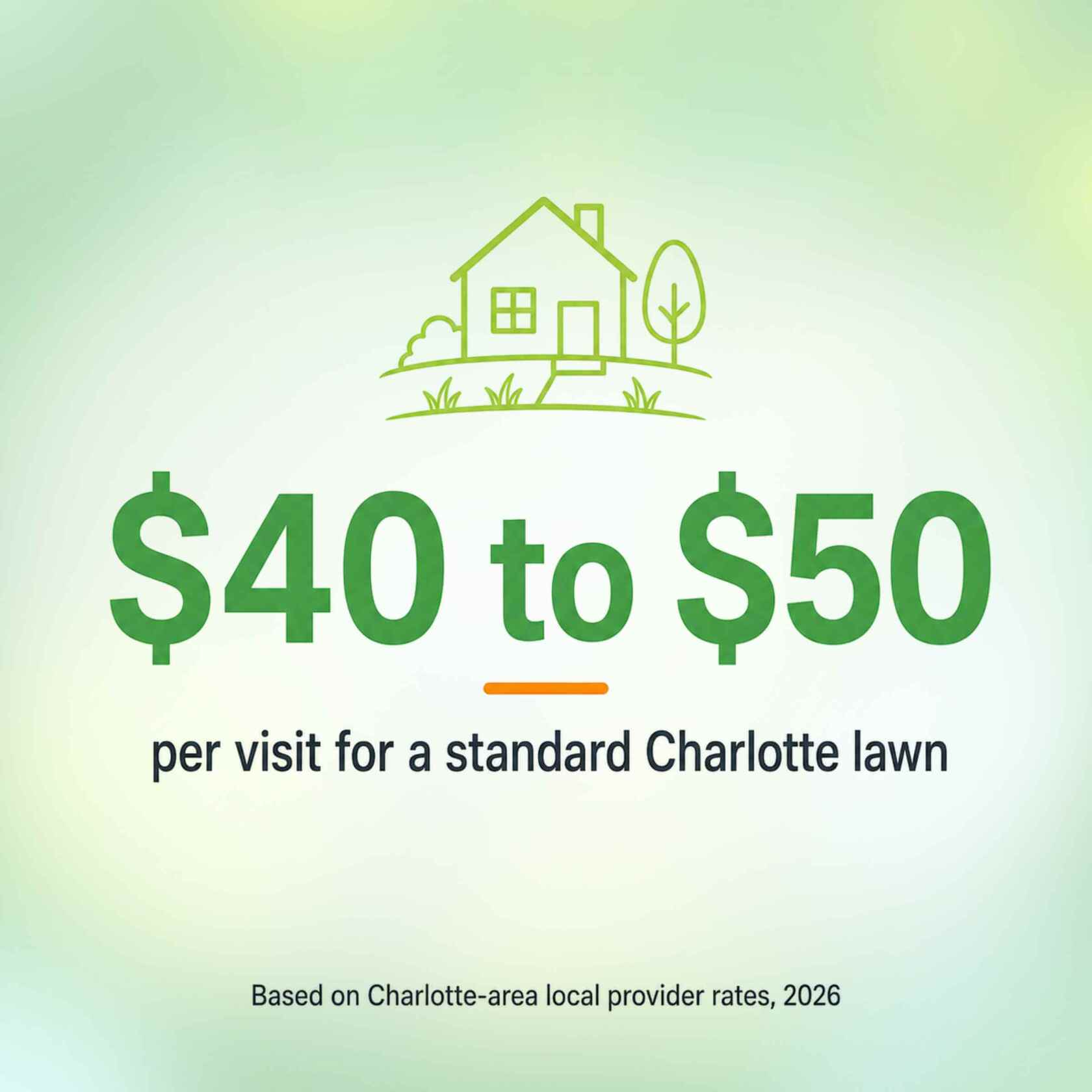
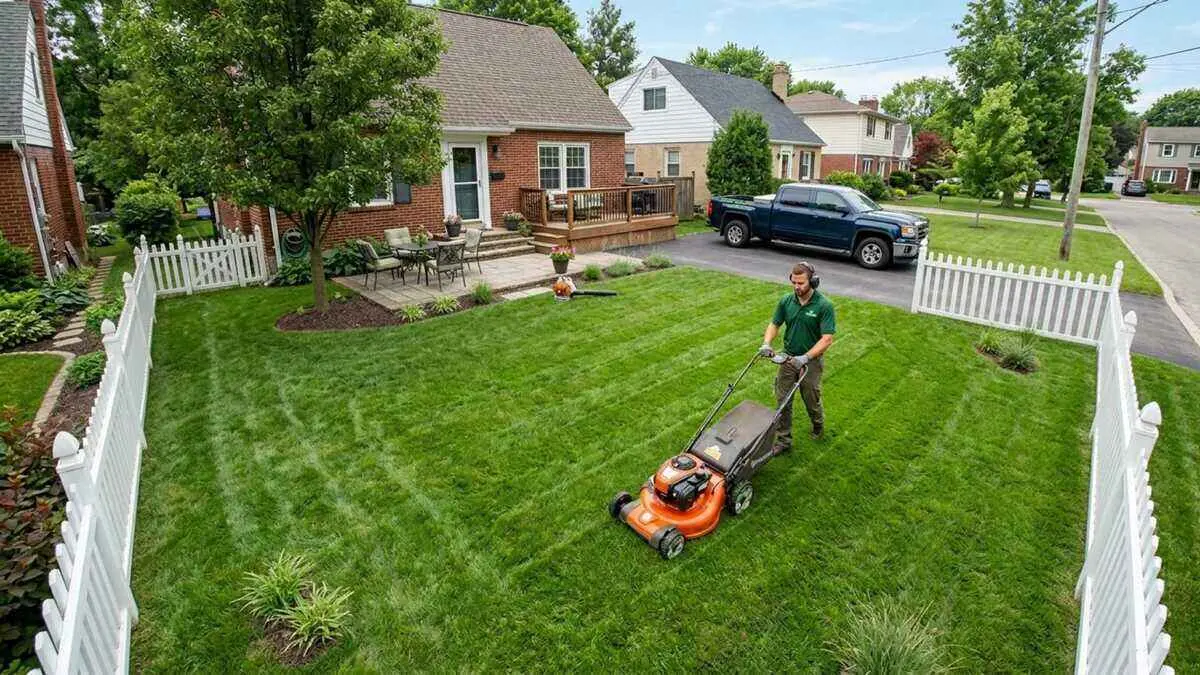
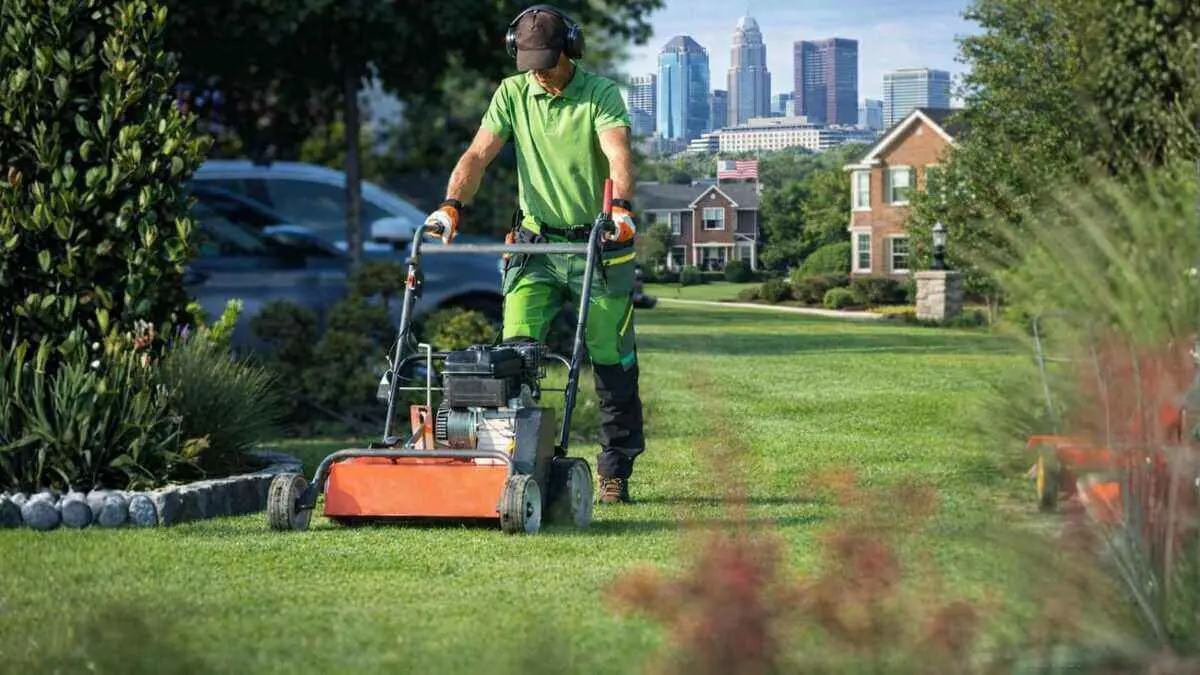
Lawn care in Charlotte typically costs $40 to $50 per visit for a standard suburban lot. That covers mowing, string trimming around obstacles, edging along driveways and walkways, and blowing the clippings off your hard surfaces. Smaller urban lots in places like NoDa or South End often run closer to $30 to $40, and the estate-sized yards common in older neighborhoods like Myers Park and SouthPark can hit $70, $120, or more. At GreenPal, we've connected over 1 million homeowners with local lawn care professionals across 250+ markets, and the Charlotte numbers in this guide reflect what local providers around Mecklenburg County are actually charging, not one company's rate card.
The thing that throws off a national average here is the grass. Charlotte sits in the turfgrass transition zone, so a single street can have cool-season fescue growing right next to warm-season bermuda or zoysia, and each one runs on its own clock. That clock, not the per-cut price, is what really sets your yearly total. Below, we break down the per-mow cost, how your yard size and grass type move the number, the add-on services Charlotte homeowners actually buy, and how to tell whether a quote is fair before you accept it.
How lawn care pricing works in Charlotte
Charlotte is a busy market across Uptown, Dilworth, Plaza Midwood, Ballantyne, University City, and surrounding towns like Concord, and all those local providers work in your favor. Instead of one company handing you a single take-it-or-leave-it number, you can put your job in front of several pros at once and let them compete for it.
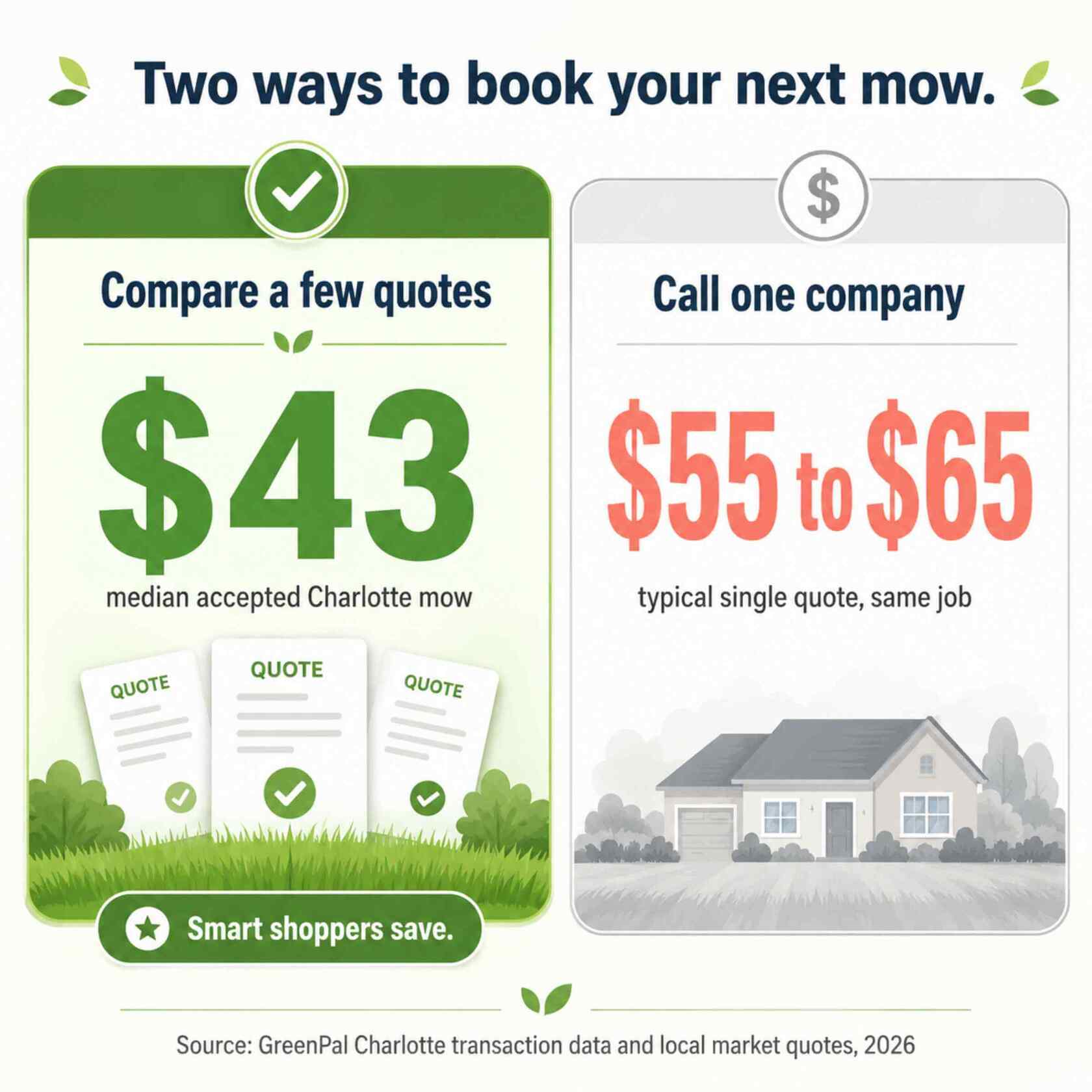
That's the whole idea behind GreenPal. You post your property details, and up to five vetted local providers send you bids, often within minutes. You compare prices, ratings, reviews, and photos of their past work, then you pick. GreenPal doesn't set the price or do the mowing. The local provider sets their own rate and does the work, and that competition is what tends to keep Charlotte rates honest instead of inflated. Across our transaction data, the median accepted price for a Charlotte mow sits around $43. Quotes from companies hired the old-fashioned way, one call at a time, frequently land in the $55 to $65 range for the same scope of work.
If you want a fuller checklist for vetting a provider beyond the price, our guide on how to choose the best lawn care company in Charlotte covers insurance, service models, and the red flags worth watching for.
What a standard Charlotte mow includes
A basic recurring visit from a Charlotte provider almost always covers four things:
Mowing the turf at the right height for your grass type
String trimming (weed-eating) around fence lines, trees, and obstacles
Mechanical edging along driveways, sidewalks, and patios
Blowing the clippings off paved surfaces so they don't track inside
Most providers mulch the clippings back into the lawn instead of bagging them, which returns nutrients to the soil. Want them bagged and hauled off? Expect that to add to the price, since it's extra labor and disposal. For a full breakdown of what goes into a single visit nationwide, see our lawn mowing cost guide.
How yard size changes the price
Lot size is the single biggest driver of what you'll pay per cut. Every provider has fixed costs to cover before they ever start your lawn (fuel, crew transit time, commercial liability insurance), so smaller lots pay more per square foot and bigger lots benefit from economies of scale.
Charlotte's lot sizes swing wildly from one street to the next. The citywide average is around 10,600 square feet, but newer infill developments can sit on lots closer to 3,000 to 3,500 square feet, while older estates run far larger. That's exactly why a firm quote handed down without a look at the property (whether by satellite imagery or an on-site walkthrough) isn't worth much. Here's roughly what local Charlotte providers charge per visit by yard size in 2026:
Yard size |
Typical lot |
Per-mow range |
Small |
Under 5,000 sq ft, compact urban lots |
$30 to $40 |
Average |
5,000 to 10,000 sq ft, standard suburban |
$40 to $50 |
Large |
10,000 to 15,000 sq ft |
$50 to $70 |
Estate |
Quarter acre and up |
$70 to $120+ |
These are per-visit ranges for routine recurring service. A one-time cut on a yard that's been left alone for a while costs more, which we get into in the surcharges section below.
How Charlotte's grass and seasons drive your yearly total
Your yearly total comes down to Charlotte's climate more than anything else. The metro falls in USDA hardiness zones 7a and 7b, right on the line of the turfgrass transition zone, where cool-season and warm-season grasses both grow but neither is in season all year. The growing window is long. Using long-term data from nearby Cabarrus County, the average last spring freeze lands around April 3 and the first fall freeze around November 1, which works out to roughly a 212-day season. A long season means more cuts, and the number of cuts, not the price of any single one, is what pushes your annual total up.
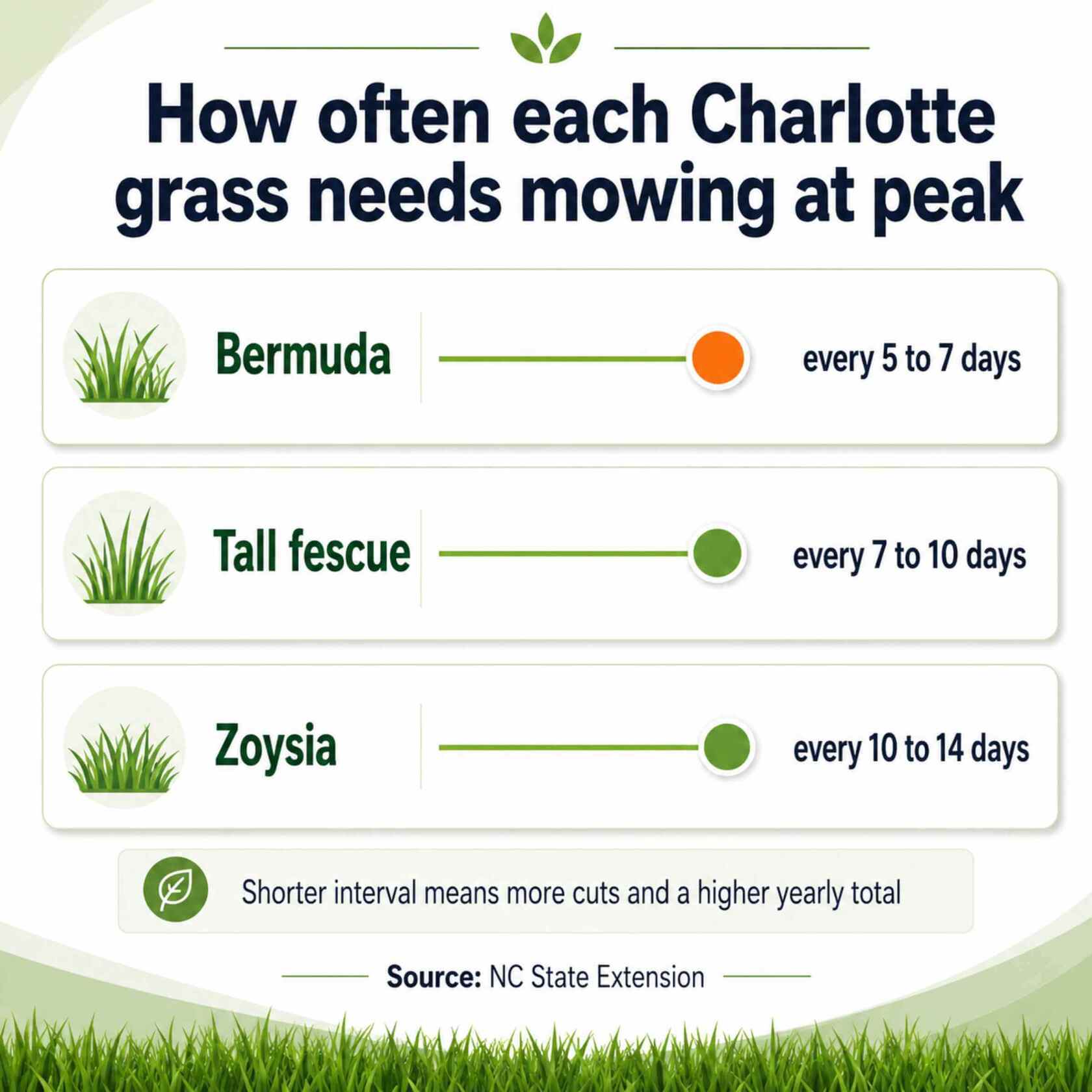
Your grass type sets the mowing frequency, and frequency is the real lever on yearly cost. According to NC State Extension, these are the three turf types you'll find across most Charlotte lawns:
Grass type |
Season |
Mowing height |
Peak frequency |
Tall fescue (cool-season) |
Greens up spring and fall |
3 to 4 inches |
Every 7 to 10 days in spring and fall |
Bermuda (warm-season) |
Thrives in summer heat |
1 to 2 inches |
Every 5 to 7 days in summer |
Zoysia (warm-season) |
Summer, slow-growing |
0.75 to 2 inches |
Every 10 to 14 days in summer |
Tall fescue is the most widely grown lawn grass in North Carolina, and because it stays green and growing through the mild spring and fall, a fescue lawn usually needs weekly mowing from March through October. Bermuda and zoysia go dormant and turn brown after the first hard freeze, so they need little to no mowing in winter. A warm-season lawn on a flat monthly plan gets less active service in the cold months, while a fescue lawn keeps the crew coming back, and that's why fescue properties usually carry the higher annual cost.
Follow the one-third rule: never cut off more than a third of the grass blade in a single pass. It protects your lawn and your wallet, and staying on a regular schedule keeps you inside it. Let the grass get ahead of you and a provider has to slow down, make multiple passes, and sometimes tack on an overgrowth fee. If your lawn has already gotten away from you, our guide on how to mow tall grass walks through the safe way to bring it back down.
To smooth out these seasonal swings, many Charlotte providers offer flat-fee monthly or budget-billing plans that spread peak-season mowing and off-season cleanups into one predictable payment. Bi-weekly programs tend to start around $159 a month, weekly fescue programs around $185 a month, and full-service contracts that bundle in treatments around $400 a month. For more on putting an annual number together, our lawn maintenance pricing guide pairs well with this section.
Add-on services Charlotte homeowners buy
Mowing is the base, but most Charlotte lawns need a few seasonal extras to stay healthy in the area's heavy Piedmont clay. Local providers price these one at a time or fold them into an annual program.
Core aeration and overseeding. Charlotte's clay soils compact easily, which chokes off water and nutrients to the roots. Core aeration pulls small plugs of soil to relieve that, and on fescue lawns it's paired with fall overseeding (September to October) to repair summer thinning. Local providers price basic aeration starting around $101, with aeration-and-seeding bundles for a standard lot running roughly $270 to $400 or more. For context, national home-improvement data from Today's Homeowner puts core aeration on a quarter-acre lot at $150 to $250. Our aeration and overseeding cost guide goes deeper on what's fair.
Seasonal leaf removal. Charlotte's mature tree canopy drops a heavy load every fall, and thick leaf mats smother grass and invite winter disease. Professional leaf removal in the area runs roughly $163 to $579 per cleanup, depending on lot size, how many trees you have, and how deep the leaves get. See our leaf removal pricing breakdown for what drives that range.
Fertilization and weed control. Program rates for regional lawn plans start around $51 a month. Priced per property, providers generally charge $13 to $15 per 1,000 square feet on smaller lawns and $8 to $10 per 1,000 square feet on medium to large properties, subject to a trip minimum.
Mulch installation. Local providers supply and spread hardwood, pine straw, or dyed mulch to keep weeds down and hold moisture in. Premium dyed hardwood mulch typically runs about $195 per cubic yard installed, often with a five-yard minimum and a delivery fee on top.
Summer fungicide. Charlotte summers are hot and humid, which leaves fescue prone to brown patch disease. Preventative applications run around $18 per 1,000 square feet, and curative treatments for an active outbreak cost roughly double.
What makes a Charlotte quote go up
A few things about your property can raise the base quote. These aren't padded fees; each one means more time, more risk, or different equipment for the provider:
Factor |
Why it adds to the price |
Overgrown grass |
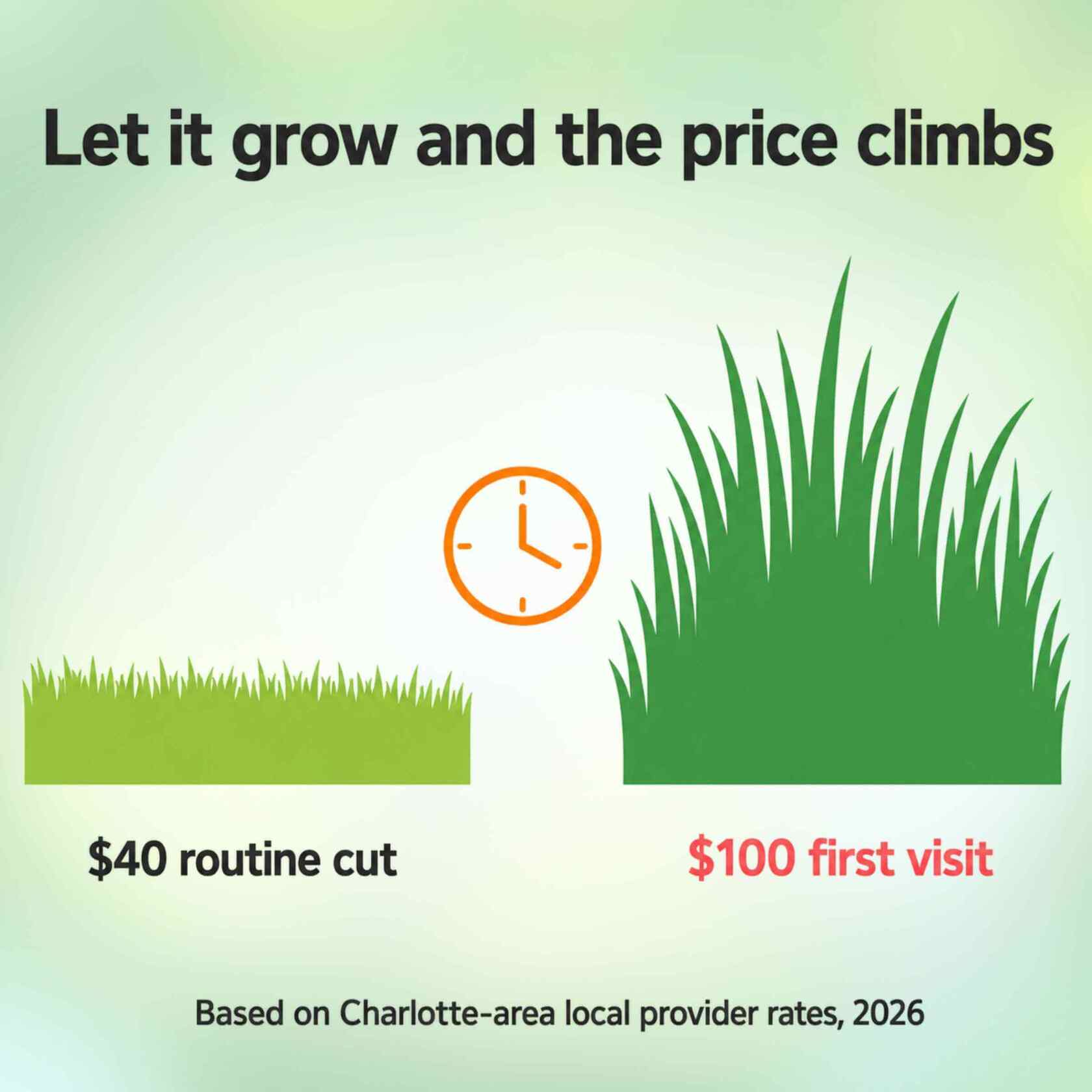
A lawn over about 10 inches needs low-gear cutting and multiple passes, so providers commonly add an overgrowth surcharge that can double a visit. Skip a couple of months and a $40 recurring cut can become a $100 first visit. |
Slopes |
Charlotte's hilly Piedmont yards force slower walk-behind mowing instead of efficient riding mowers. |
Narrow gates |
A backyard gate under 36 to 48 inches blocks larger mowers and forces the crew onto smaller equipment, which adds time. |
Obstacles and heavy edging |
Plenty of trees, beds, fence lines, and long hardscape edges mean more trimming and edging on every visit. |
How to tell whether a Charlotte quote is fair
Charlotte's labor market sets a floor under pricing. According to the Bureau of Labor Statistics, the mean hourly wage for the building and grounds cleaning and maintenance group in the Charlotte-Concord-Gastonia metro was $17.81 as of May 2024. Add fuel, equipment, and insurance on top of that, and you can see why a quote well below market often points to an uninsured or corner-cutting operation. Here's what to confirm before you say yes to any bid:
What to check |
Why it matters |
Itemized scope |
Confirm the quote spells out edging, whether clippings are mulched or bagged, and the rain-delay policy |
Insurance |
Look for active general liability and workers' comp; the residential industry standard is $500,000 to $1,000,000 in coverage |
Property look |
A firm price set without satellite imagery or an on-site walkthrough is a red flag, given how much Charlotte lots vary |
Written terms |
Cancellation timelines and any auto-renewal should be in writing, not verbal |
Be wary of door-to-door "splash and dash" sales pitches, demands for a big cash-only deposit, and any company that won't put its terms in writing. If a number looks too good to be true for your yard size, it usually is. Our guide on what a fair hourly rate for lawn care looks like gives you benchmarks to sanity-check any bid.
How competing quotes help you pay a fair price
The best way to know you're paying a market rate is to compare a few quotes side by side instead of booking the first company you call. When local pros compete for the same job, the price tends to land where the market really is, and you get to weigh ratings and past-work photos right alongside the number.
A couple of things on our end are built to keep that honest. Every provider is screened on equipment, references, identity, and business credentials before they're allowed to bid, and they have to hold strong ratings to keep getting work. After the job, your provider posts timestamped photo proof, and you review the finished work before your card is charged by the lawn company you hired. It's free for homeowners, with no signup, membership, or quote fees. And most homeowners don't even need to be home, which is a big part of why so many of our users, including a large share who are 60 and older, like the contactless, no-phone-tag way of doing it. To see the whole process start to finish, here's how GreenPal works.
Compare Charlotte lawn care quotes for free
Charlotte lawn care pricing comes down to your yard size, your grass type, how often it gets cut, and which seasonal services you add on. The surest way to land a fair rate is to let local pros compete for your business.
Want to see what providers in your neighborhood would charge for your yard? Get free competing quotes from vetted Charlotte lawn care pros on GreenPal and pick the one that fits your price and your schedule. Live outside the city? You can compare local pros anywhere in the state on our North Carolina lawn care services page.




 Do bidding platforms for lawn care actually save me money compared to traditional hiring?
by Gene Caballero | March 08, 2026
 I heard about GreenPal for lawn care. Is it better than just using Google to find someone?
by Gene Caballero | May 08, 2026
 GreenPal vs. Lawn Doctor: Which Lawn Care Service is Right for You?
by Gene Caballero | June 30, 2026




 What Causes Dirt Mounds in My Yard? (And How to Tell What’s Behind Them)
by Gene Caballero | April 08, 2026
 Lawn Mower Tire Marks on Driveways: Causes, Fixes, and Prevention Tips
by Gene Caballero | April 08, 2026
 The Green Gauntlet: An Exclusive Report Ranking U.S. Cities by Lawn Enforcement Severity
by Gene Caballero | April 08, 2026