


How Much Does Lawn Care Cost in Denver, CO? (2026)
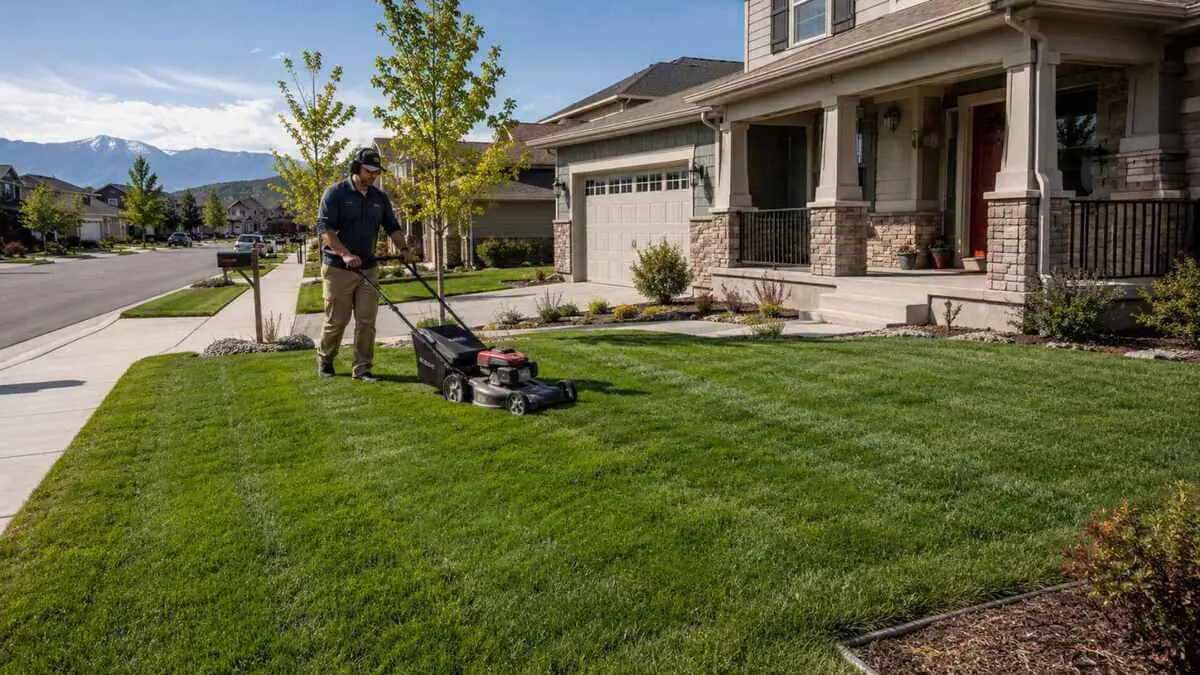
Most Denver homeowners pay about $40 to $55 per visit to have a standard suburban lawn mowed, with prices across the metro ranging roughly $40 to $194 depending on lot size, terrain, turf type, and how overgrown the grass is. Those rates are set by local lawn care providers competing for the work, not by any single company. At GreenPal, we connect Denver homeowners with vetted local lawn care pros who send back up to five competitive quotes, often within minutes, so you can compare real Front Range prices side by side instead of accepting one assigned number.
A few things make Denver pricing different from what a generic national guide will tell you. Denver lawns run on cool-season grass that grows hardest in spring and fall. The soil is heavy clay, which turns core aeration into a routine cost rather than an optional extra. The climate is semi-arid, and local watering rules change what a lawn actually needs. And winters are real, so snow removal and sprinkler winterization land in the yearly budget right alongside mowing. Here is what a Denver yard actually costs to keep up, and what pushes the number up or down.
What does lawn mowing cost in Denver per visit?
For a standard suburban lawn, roughly 2,500 to 5,000 square feet, Denver lawn care providers typically charge $40 to $55 per visit for routine mowing, edging, trimming, and clearing clippings off hard surfaces. Across all property sizes the metro average runs closer to $116 per visit, but that figure is pulled up by larger and more complex yards. A typical suburban lawn sits well below it.
Price scales with size, though not in a straight line. The per-square-foot rate usually drops as the lawn gets bigger, landing around $0.01 to $0.02 per square foot in the Denver area. The reason is that a big share of any visit is fixed cost. Loading, driving, unloading, and setting up take the same time whether the lawn is small or large, so spreading that over more square footage lowers the rate.
Lawn size |
Typical Denver per-visit range |
Small or standard suburban (2,500 to 5,000 sq ft) |
$40 to $55 |
Larger residential lot |
$55 to $120 |
Oversized or corner lots, complex yards |
$120 to $194 |
Competitive bidding is what keeps these numbers honest. For smaller lawns in active Denver neighborhoods, quotes from local pros can start around $39 a mow. If you want the math behind a mow anywhere in the country, our guide to national lawn mowing prices breaks down the cost drivers in detail.
How service frequency changes the price
How often you mow has a direct effect on your per-visit rate. A consistent weekly or biweekly schedule almost always beats one-off calls on price, because a regular customer is predictable to route. One-time and on-demand visits carry the highest rate.
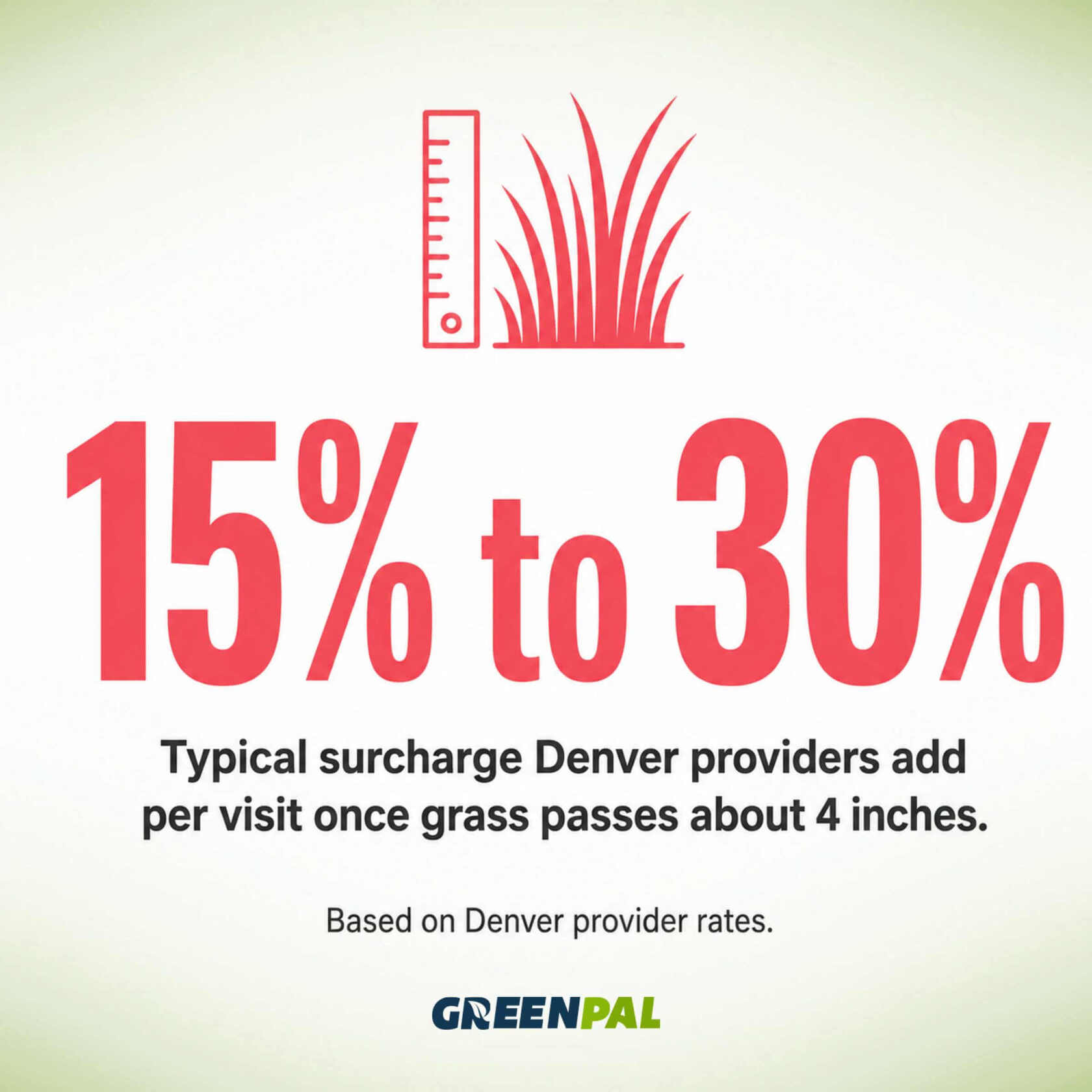
There is an agronomic reason consistent mowing costs less, too. A weekly cadence keeps a provider inside the one-third rule for mowing, which says no more than a third of the grass blade should come off in a single cut. Stretch mowing to biweekly or monthly during peak growth and the grass gets tall and dense. Crews then slow down, make extra passes, bag clippings instead of mulching them, and wear blades faster. To cover that added labor, providers tack on height surcharges of roughly 15% to 30% once the grass passes about 4 inches.
Schedule |
Cost effect |
Weekly |
Lowest per-visit rate, keeps grass inside the one-third rule |
Biweekly |
Slightly higher per-visit rate, height surcharges likely in spring and fall |
Monthly or one-time |
Highest per-visit rate, surcharges common |
Denver grass types and the growth calendar
Denver lawns are predominantly cool-season grasses, mainly Kentucky bluegrass and fescue, with buffalo grass showing up as a water-wise native option. Cool-season turf has a distinct growth rhythm, and that rhythm drives both your mowing schedule and your seasonal spend.
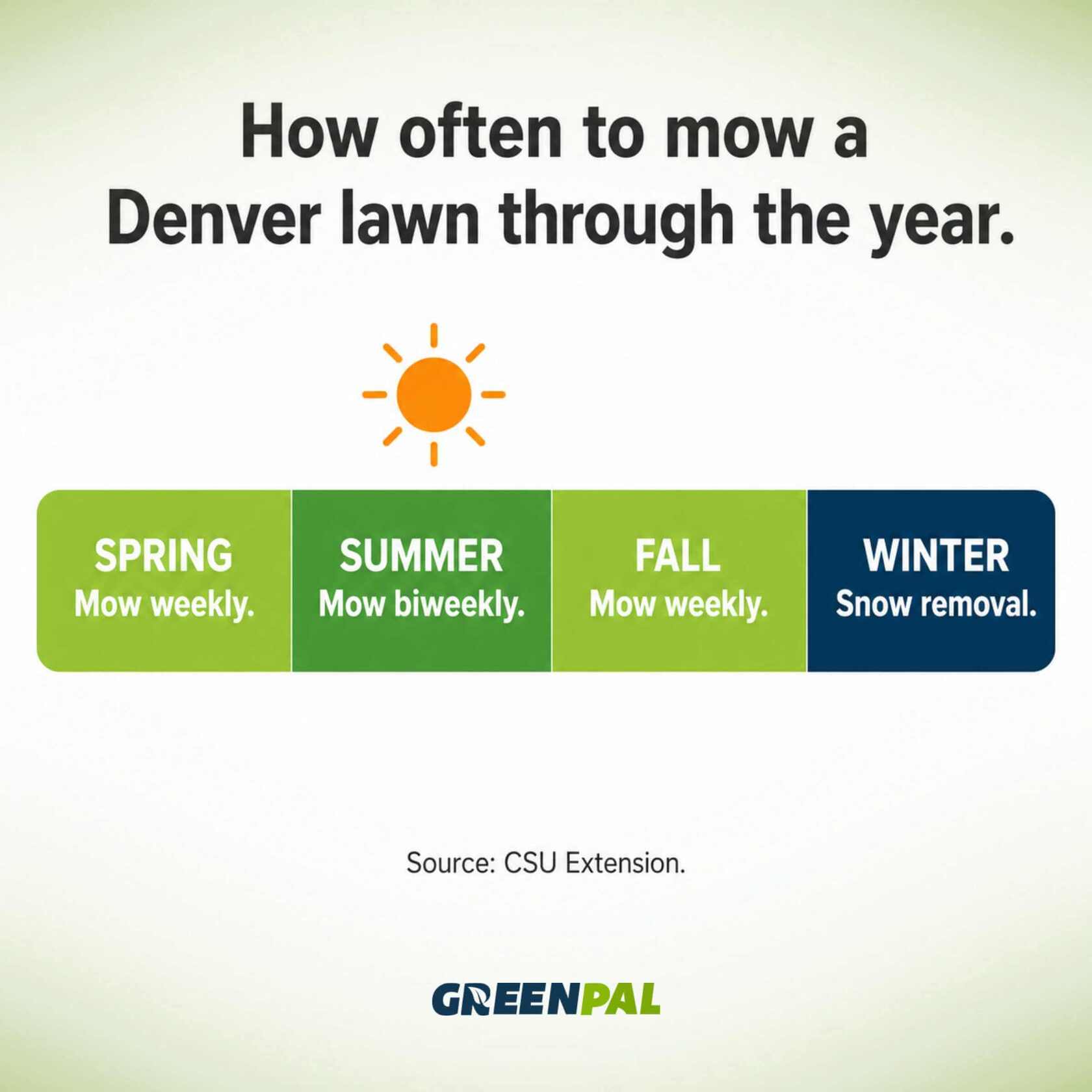
These grasses grow hardest in spring and again in fall, when temperatures are mild. That is when a weekly schedule earns its keep, and when skipping a week most often triggers a height surcharge. In the heat of midsummer, cool-season growth slows down, and many homeowners can stretch to biweekly mowing without losing control of the lawn. Planning frequency around that calendar, weekly in spring and fall and biweekly through peak summer, is one of the simplest ways to hold mowing costs down while staying inside the one-third rule. Colorado State University Extension's turf management guidance covers the timing in depth.
Clay soil and core aeration
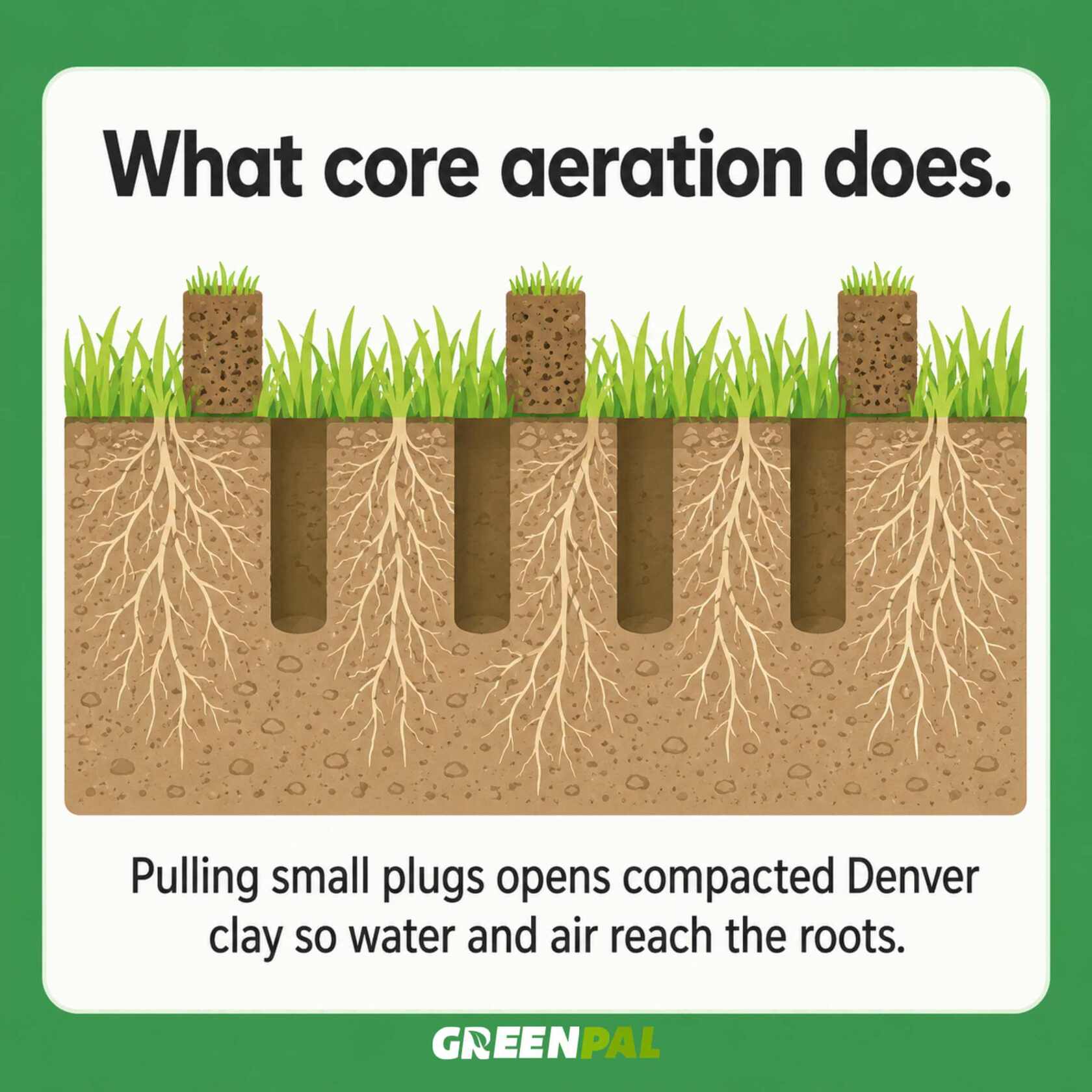
A major cost driver specific to the Front Range is the soil. Much of the Denver metro sits on heavy clay soil, and clay compacts badly under foot traffic, rain, and irrigation. Compacted clay leaves little room for air and water to move, which starves roots and leaves you with thin, drought-prone turf.
The fix is routine core aeration, which pulls small plugs of soil to open the ground back up. In Denver's clay, providers usually run aeration once or twice a year, and it belongs in your budget as a recurring cost. Expect to pay roughly $50 to $200 per visit depending on lawn size, with smaller standard lawns at the lower end and larger properties costing more. Aeration also helps water soak in deeply instead of running off, which matters a lot under Denver's watering limits. Our breakdown of core aeration and overseeding costs shows what fair pricing looks like.
Watering rules and what they mean for cost
Water is the most volatile cost factor for a traditional Denver lawn, and local rules shape what the lawn needs. Under Denver Water's summer watering rules, outdoor watering is limited to assigned days, and you cannot water during the peak evaporation window in the middle of the day. In drought conditions, watering can drop to two days per week, and households that use more than average can face seasonal surcharges of roughly $40 to $200 across the May to October irrigation season.
That makes aeration and overseeding more valuable, because they help the grass do more with less water, and some homeowners convert thirsty turf to native, water-wise plantings. Denver Water offers a discount of up to $750 toward removing at least 200 square feet of Kentucky bluegrass, and some Denver-area cities add their own turf-replacement rebates on top, which can offset the upfront cost of converting part of a yard. Local 9News covered the $750 turf discount and how it works through a regional nonprofit.
Terrain, slope, and access
Two yards of the same size can carry different prices based on how easy they are to work. A handful of factors add time, and providers price for it:
Narrow gates and entryways under about 36 inches force crews onto smaller walk-behind mowers instead of faster wide-deck machines, which adds labor time.
Steep slopes and rocky ground, common in Denver's foothills and western suburbs, call for careful maneuvering and can add roughly 20% to 40% to a base mow.
Locked gates, fences, trees, and tight access points all slow a job down.
Asking for a specific day of the week instead of the provider's routing day can add about 10% to 15%, and same-day or rush service can add 30% to 50%.
Overgrown lawns and the neglect surcharge
If a lawn has gotten away from you, the first visit will cost more. Tall, dense grass takes extra passes and slower cutting, so a one-time cleanup of a neglected lawn can run up to double a normal mow. Once it is back on a regular schedule, pricing returns to standard rates. If your grass is already past the point of a normal cut, our guide on what to do when you let it get too tall walks through the reset.
Winter costs every Denver homeowner should budget for
A Denver lawn budget does not end in October. Freeze-thaw cycles start as early as September, and they bring a few seasonal costs that warm-climate guides never mention.
Sprinkler winterization, also called a blowout, clears water out of irrigation lines so they do not freeze and crack. Providers typically charge $75 to $150 for a standard residential system when you schedule early, in September or October. Wait until after a hard freeze and late-season or emergency calls can add 50% to 100% to that price.
Snow removal is the other winter line item, and it is one we help Denver homeowners handle. Local providers bill snow removal per visit, hourly, or on a seasonal contract. Typical per-visit clearing of a driveway and sidewalks runs $60 to $180, and the price tracks the snowfall.
Snowfall |
Typical per-visit snow removal cost |
6 inches or less |
$65 to $110 |
12 to 18 inches |
$130 to $250 |
Because we connect Denver homeowners with snow removal pros through the same competitive bidding model, a Denver yard can be handled year-round by the same kind of vetted local pro who mows it in summer. You can see how snow removal works on the platform.
Sales tax on Denver lawn care
In Colorado, routine lawn services like mowing, edging, and trimming count as labor and are not subject to sales tax. Materials are a different story. Sod, grass seed, fertilizer, mulch, soil amendments, and rock are taxable goods. Colorado's state sales tax is 2.9%, and because Denver is a home-rule city with its own local taxes, the combined rate on materials in Denver lands around 9.15%.
If a provider bills labor and materials together as one lump sum, the whole invoice can be taxed. If labor and materials are itemized separately, tax applies only to the materials. Asking for an itemized invoice keeps you from paying tax on professional labor. The Colorado Department of Revenue's sales tax guide explains how the state treats goods versus services.
How neighborhood affects price
Pricing varies across the Denver metro, which is normal for any large market. Lot sizes, drive time, terrain, and local demand all factor into what a provider quotes. The most reliable way to see what your specific address costs is to collect a few quotes from providers who actually serve your area, rather than assume a single citywide number applies to your yard.
A realistic annual lawn care budget for Denver
Pulling the pieces together, here is what a full year looks like for a typical standard suburban Denver lawn. Every figure is a provider rate set by the local market, and your real total depends on lot size, how often it snows, and which add-ons you use.
Service |
Typical annual range |
In-season mowing (weekly to biweekly, roughly April to October) |
$1,100 to $1,500 |
Core aeration (one to two visits) |
$75 to $400 |
Sprinkler blowout (winterization) |
$75 to $150 |
Snow removal (varies by winter) |
$0 to $700+ |
Seasonal cleanups |
More than a standard mow, based on debris |
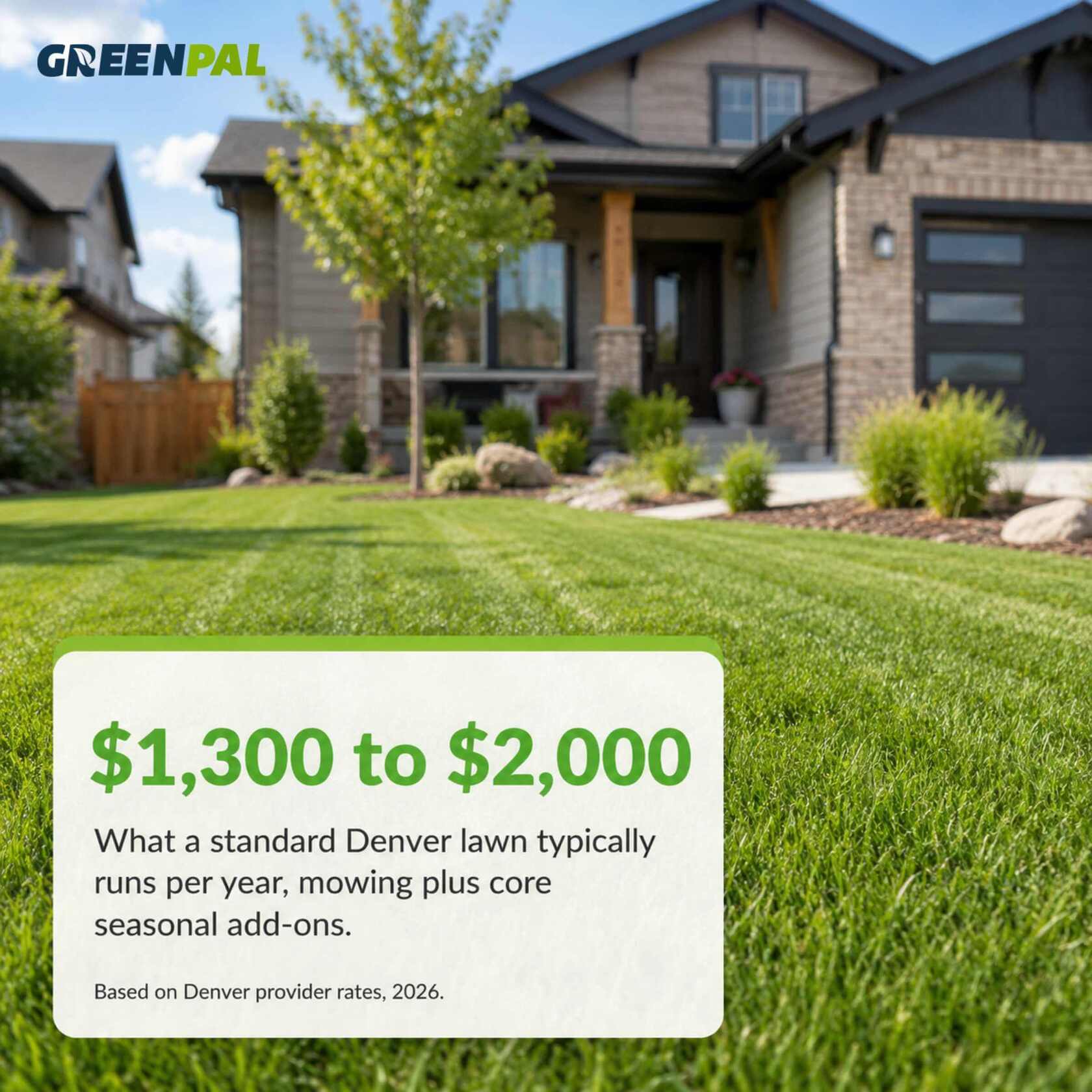
For a standard suburban lawn, mowing plus core seasonal add-ons usually lands around $1,300 to $2,000 a year, climbing toward $2,500 or more in a heavy snow winter or on a larger lot. Bigger properties, full-service programs, and frequent snow events push it higher. For a national view of what a complete program runs, see our guide to full-service lawn care costs and our broader lawn maintenance pricing guide.
If you are on a fixed budget, including the many Denver seniors who use lawn care services, comparing quotes is the single best way to keep costs in check. Our notes on affordable lawn care for seniors cover how the contactless model works when you would rather not be home for every visit.
How to get an accurate Denver quote
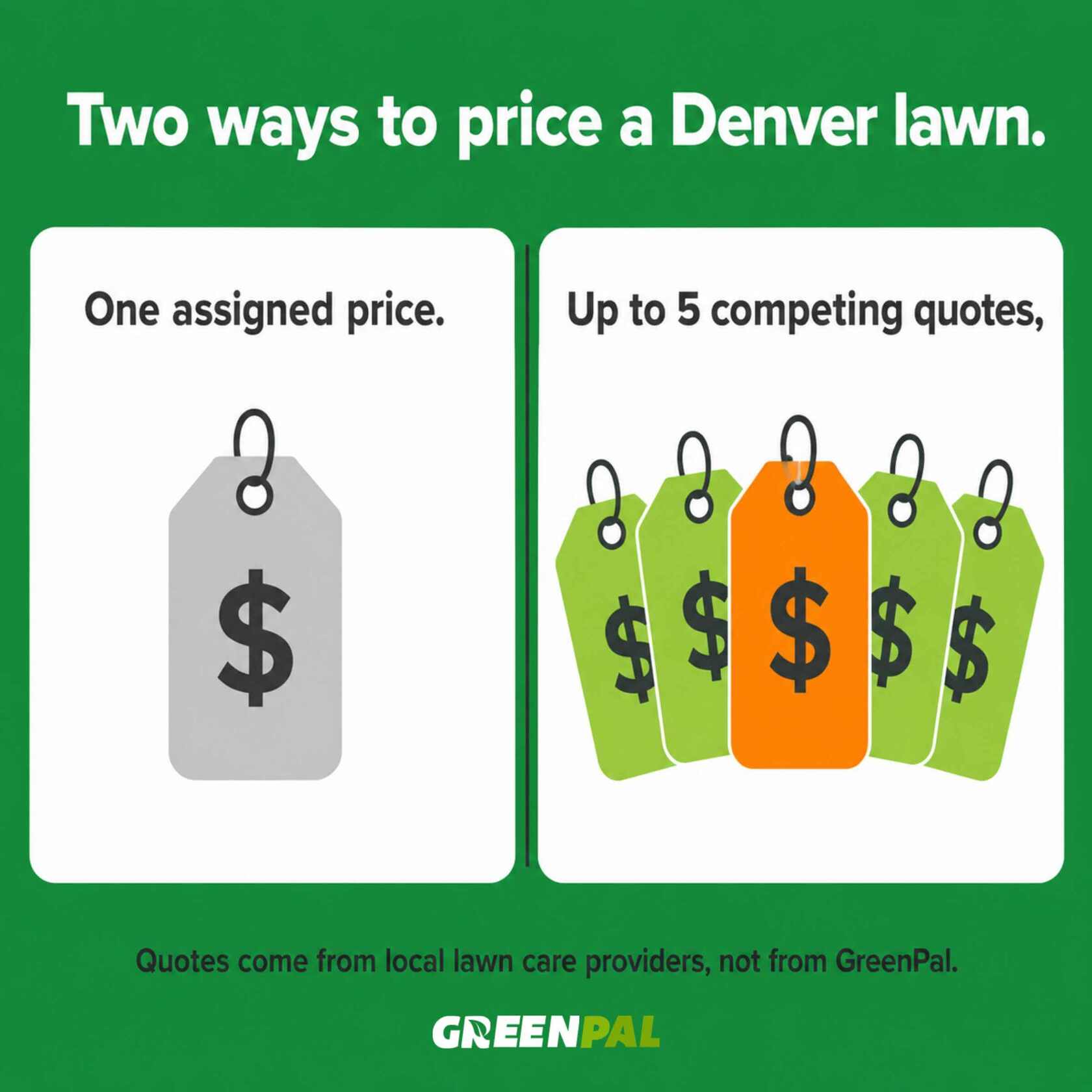
Online averages only get you so far. The number that matters is what a vetted local pro will charge for your specific lawn, on your schedule. That is where comparing real bids beats accepting an assigned price.
GreenPal is free for homeowners, with no signup fee, membership, or service-request charge. You submit your lawn details in under a minute, our satellite-based sizing helps providers bid accurately, and you get up to five competitive quotes from screened Denver pros, often within minutes. Providers are vetted on equipment, references, and business and background checks, so you are choosing from real local professionals. You see ratings and reviews before you pick, and the provider charges you only after the work is done and confirmed with a time-stamped photo. If you want to see the whole flow, here is how GreenPal works.
Frequently asked questions
How much is a single mow in Denver?
A standard suburban Denver lawn, around 2,500 to 5,000 square feet, typically costs $40 to $55 per visit. Larger or more complex yards can run up to about $194.
What is the per-square-foot cost of lawn mowing in Denver?
Denver providers generally price around $0.01 to $0.02 per square foot, and the rate tends to drop as the lawn gets bigger because the fixed setup time is spread across more area.
How often should you mow a lawn in Denver?
Mow weekly during the spring and fall peak growth of cool-season grasses, then stretch to biweekly through the slower midsummer heat. A consistent schedule keeps grass inside the one-third rule and avoids height surcharges.
Is lawn aeration worth it in Denver's clay soil?
Yes. Heavy Front Range clay compacts easily, and core aeration opens the soil so water and air reach the roots. Most Denver lawns benefit from one or two aerations a year, typically $50 to $200 per visit depending on lawn size.
Does GreenPal offer snow removal in Denver?
Yes. Local pros handle driveway and sidewalk clearing through the same competitive bidding model, usually $60 to $180 per visit depending on snowfall.
Get competitive Denver lawn care quotes
Denver pricing comes down to your lawn, your schedule, and which local pro you hire. Rather than guess from an average or accept one assigned rate, we make it simple to compare local Denver quotes from vetted lawn care providers and pick the one that fits your yard and your budget. It is free to start, and you only pay your provider after the work is done.


