Liquid vs. Granular Fertilizer: Which Is Best For Your Lawn?
Comparing liquid and granular fertilizer is a bit like comparing apples and oranges. Neither is inherently better for your lawn, they simply serve different purposes.
Granular is best for long-term seasonal feeding and larger yards. It's easier to apply over large areas, and slow-release formulations feed the lawn gradually over weeks or months. Liquid fertilizer is best for swift greenups — it's a bit like an energy drink for lawns that need immediate help.
Liquid Fertilizer |
Granular Fertilizer |
|
Application Method |
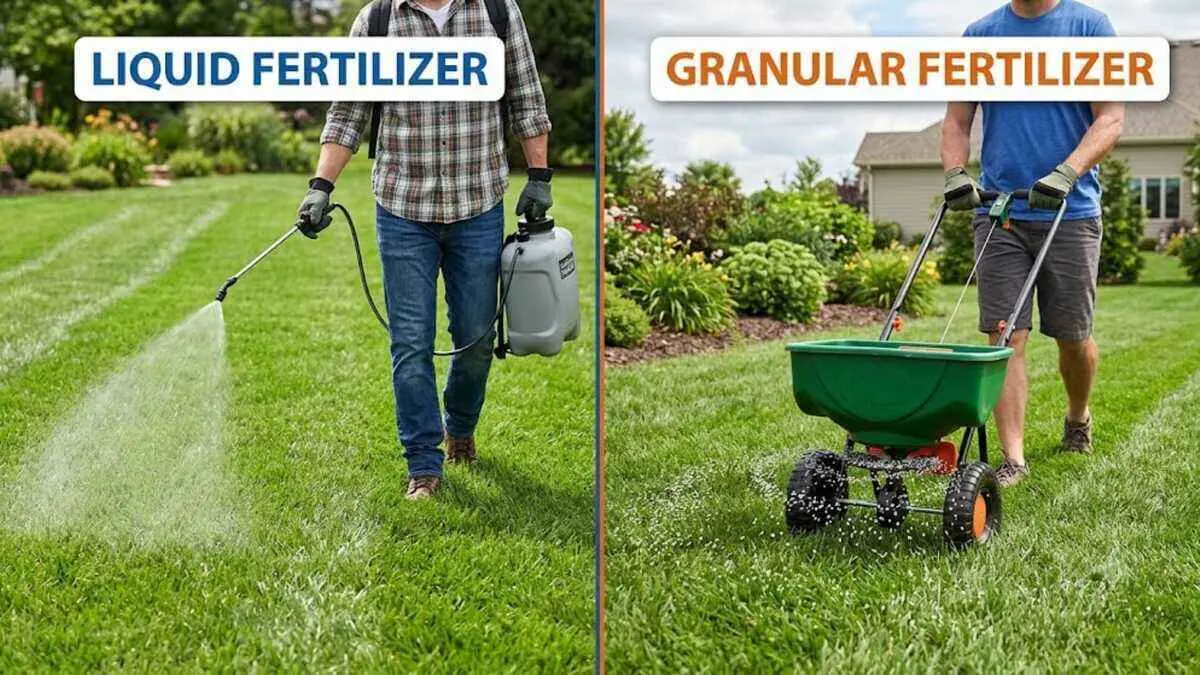
Typically loaded into a garden sprayer or attached to a garden hose. |
Applied via a broadcast spreader or drop spreader. |
Absorption Rate |
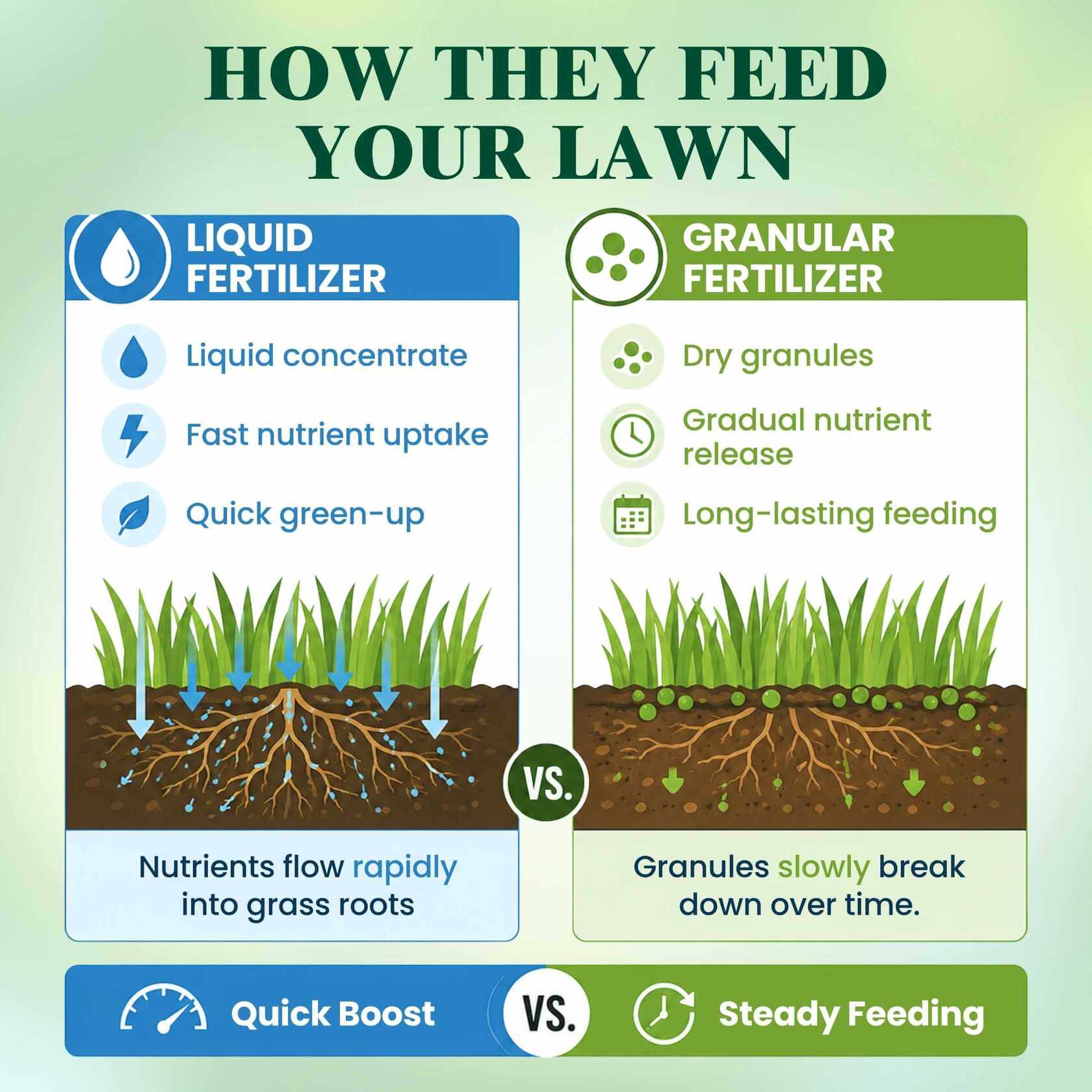
Fast-release formulations make nutrients readily available and absorbed quickly. |
Slow-release formulations release nutrients gradually over several weeks or months. |
Spatial Differences |
Allows nutrients to travel more quickly through the soil and reach the grass roots. |
Nutrients remain bound within the granule, taking longer to make contact with the roots. |
Salt Content |
Usually has a lower salt content, which may lower the risk of fertilizer burn. |
Usually has a higher salt content, which may increase the risk of fertilizer burn. |
Reapplication |
Fast-release formulations require more frequent reapplication to maintain consistent nutrient availability. |
Slow-release formulations provide consistent nutrient availability and require less frequent reapplication. |
Nutrient Consistency |
Every droplet has the same concentration of nutrients, allowing for uniform nutrient distribution. |
In multi-nutrient products, granules are not homogeneous. Each granule contains an individual nutrient, which can result in uneven nutrient distribution. |
Cost |
Liquid fertilizer is typically less cost-effective, covering less area per dollar. |
Granular fertilizer is typically more cost-effective, covering more area per dollar. |
Note: While liquid fertilizers are typically fast-release and granular fertilizers are typically slow-release, fast-release and slow-release formulations exist for both liquid and granular fertilizers.
What Is Liquid Fertilizer?
Liquid fertilizer is a plant food concentrate that dissolves easily in water and provides an instant burst of essential nutrients to the grass.
It’s generally referred to as fast-release or quick-release fertilizer, however, specialized slow-release liquid fertilizers are available.
What Is Granular Fertilizer?
Granular fertilizer is a plant food available as dry pellets or granules that slowly releases nutrients to the soil. Many granular fertilizers are polymer-coated, with the coating gradually breaking down through irrigation, rain, or microbial activity to release nutrients over weeks or months.
It’s generally referred to as slow-release fertilizer, however, specialized fast-release granular fertilizers are available.
Pros and Cons of Fast-Release Liquid Fertilizer
Again, there’s no clear winner between fast-release liquid fertilizer and slow-release granular fertilizer. It really just comes down to what you’re trying to achieve. If your lawn needs a color boost for a special event or immediate rescuing from damage, a liquid fertilizer may be ideal.
Pros
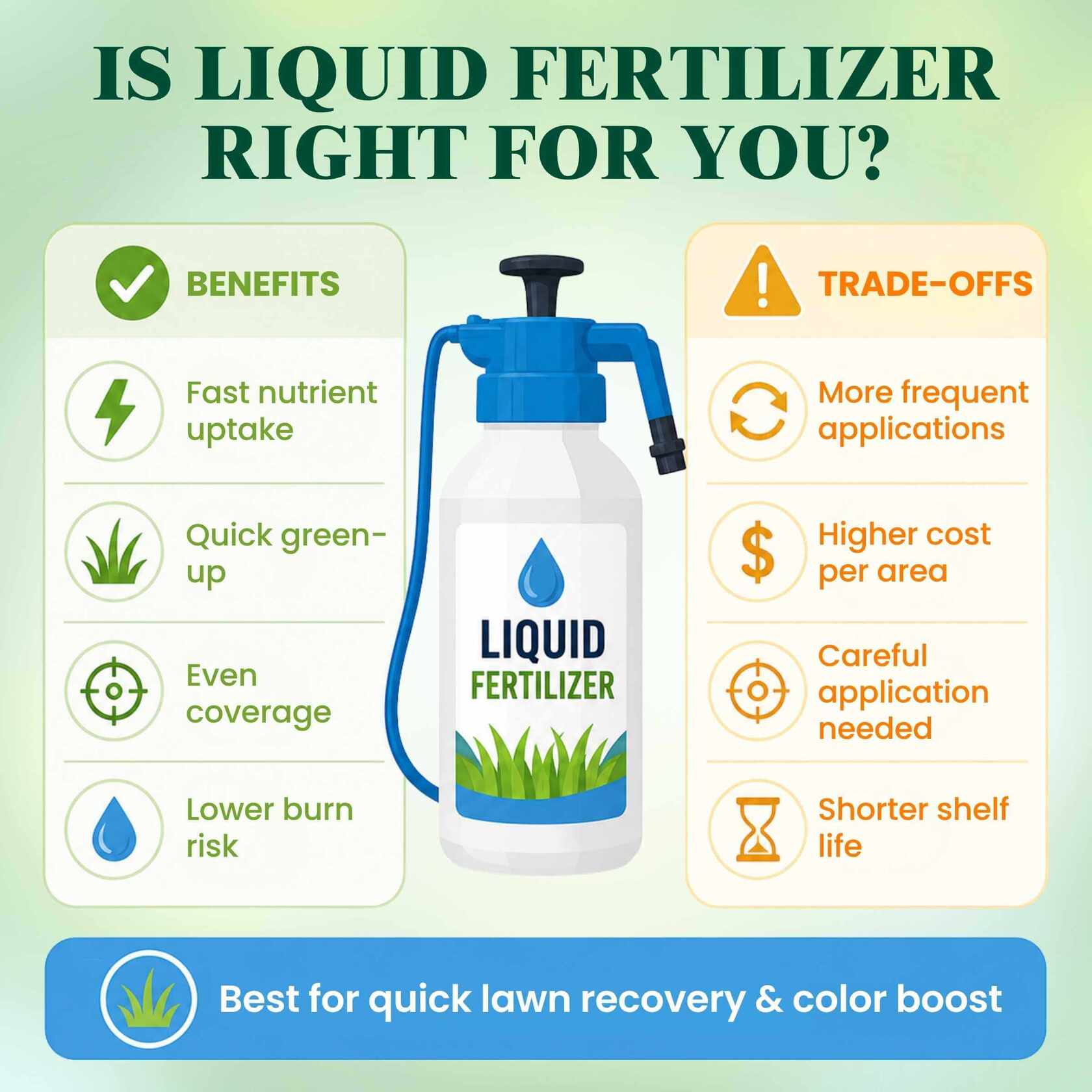
Nutrients are immediately available to the grass roots and foliage.
Nutrients, especially slow-moving nutrients like phosphorus, can move more easily through the soil and reach the grass roots faster.
Each droplet has the same concentration of nutrients, allowing for even nutrient distribution when applied correctly.
Uniform coverage can be achieved when applied correctly, especially with the aid of an indicator dye that shows where you have and haven’t applied.
Usually has a lower salt content, which may lower the risk of fertilizer burn.
Can provide a quick blast of nutrients to green up a struggling lawn or prepare it in time for a special event.
-
Can be easily attached to the garden hose and doesn’t require large equipment, such as a broadcast spreader.
( GreenPal Marketplace )Get 5 free bids from local lawn prosTop-rated pros near you send real quotes in minutes — no contracts, no haggling.Get My Free BidsNo credit card required. Get matched in 60 seconds.
Cons
Does not provide a continuous supply of nutrients over long periods, increasing the need for reapplication.
Less cost-effective than slow-release granular fertilizer, covering less area per dollar.
Misapplication can lead to uneven coverage, such as spraying by eye or without an indicator dye. This can lead to burned or skipped areas.
Applying over large areas may prove tedious, often requiring reloading heavy tanks and mixing multiple batches.
Generally have a shorter shelf-life than granular fertilizers.
Pros and Cons of Slow-Release Granular Fertilizer
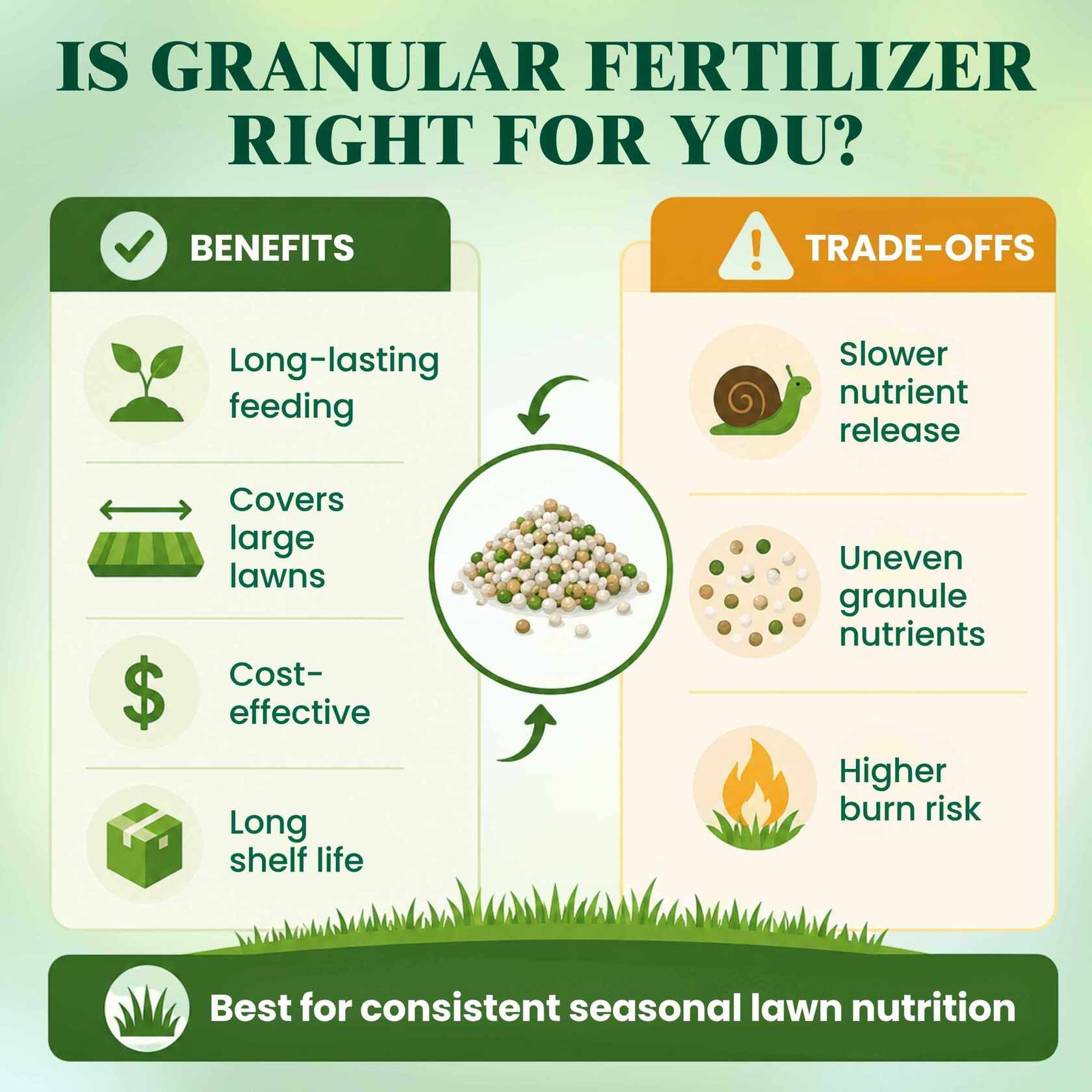
Slow-release granular fertilizer gradually releases nutrients over weeks or months. This is ideal for established lawns that need a steady supply of nutrients throughout the season rather than a quick, short-lived boost.
Pros
Provides steady, long-term feeding without overwhelming the turf.
Uniform distribution can be achieved when applied correctly.
Covers large areas in a short amount of time when using a drop or broadcast spreader.
More cost effective than liquid fertilizer, covering more area per dollar.
Has a longer shelf-life than liquid fertilizer.
Cons
In multi-nutrient products, granules are not homogeneous. Each granule contains an individual nutrient, which can result in uneven nutrient distribution.
Usually has a higher salt content than liquid fertilizer, which may increase the risk of fertilizer burn.
Nutrients take longer to reach the roots and are not instantly available, which may not be ideal for lawns that need immediate rescuing or a quick greenup.
Final Verdict: Which Is Right For Your Lawn?
The key to choosing between granular and liquid fertilizer comes down to understanding how each one works and what your lawn needs. In fact, your fertilizer routine can include both throughout the year. Liquid is great for a quick restorative boost and granular for sustained lawn health.
Fertilizer is just one piece of the puzzle. Mowing, aeration, and routine maintenance are all part of keeping a lawn healthy year-round — and managing it all can be a lot of work. That's where GreenPal comes in, making it easy for homeowners to find local lawn care professionals and companies in cities across the country, including Spokane, WA, Lake Tahoe, NV, and Amarillo, TX.