


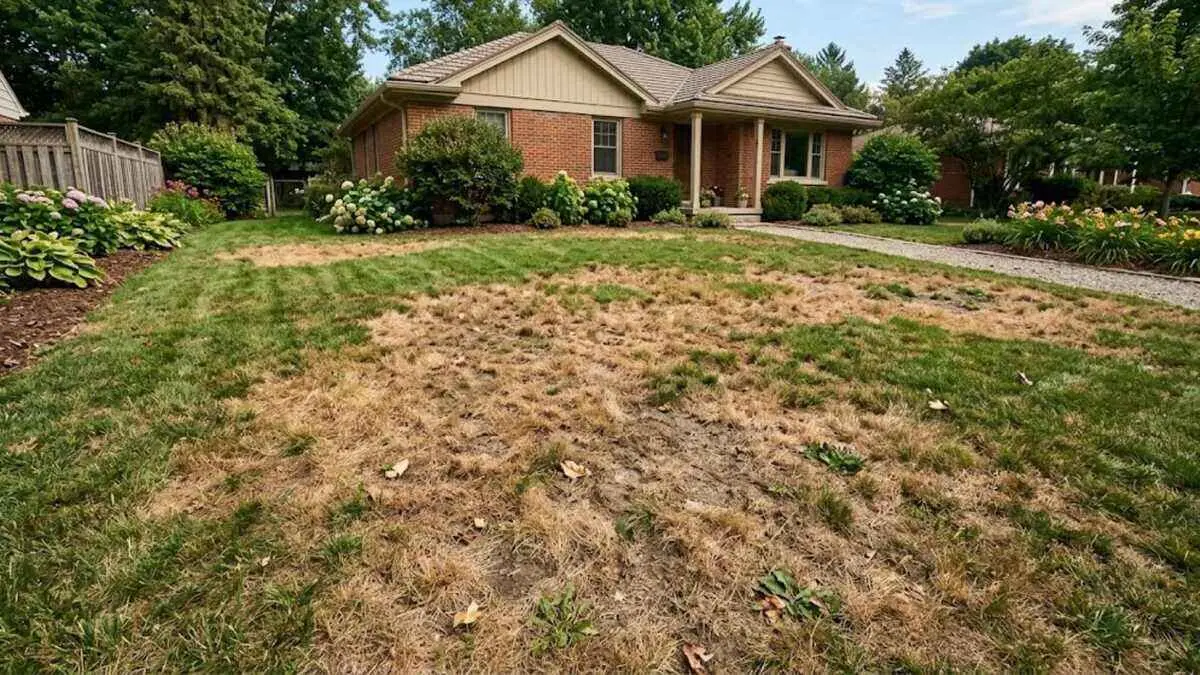
Why Your Lawn Is Dying In Patches
When your lawn develops large brown spots, it’s usually a cry for help. A pest may be feeding on the roots, the lawn mower may be injuring the grass, or the soil quality may be poor. We'll explore many possible reasons why your lawn is dying in patches and how to fix them.
Grubs or Other Lawn Pests
White grubs are the C-shaped larvae of scarab beetles, such as Japanese beetles, June beetles, and masked chafers. Grubs live in the lawn’s soil and feed on its roots, resulting in large dead patches across the yard.
To confirm whether it’s grub damage, try pulling the affected area off the ground. If it rolls up like carpet, grubs have likely severed the roots underneath.
Other pests can cause similar damage: chinch bugs suck moisture from grass blades, leaving yellowed patches that turn brown, while sod webworms chew through grass stems at the soil surface, creating ragged, thinning areas.
Solution: If the grub infestation is severe, consider applying curative insecticides that kill all larval stages of grubs. To prevent the next generation, apply preventative insecticides before eggs hatch, typically in mid-to-late summer. To learn more, visit How to Get Rid of Lawn Grubs.
Lawn Disease
Lawns that are overwatered, undermaintained, or damp for long periods of time are often susceptible to fungal diseases.
Common lawn diseases that develop brown or tan patches in the lawn include dollar spot, large patch, brown patch, red thread, and snow molds. Left untreated, these patches of grass eventually die.
In addition to unsightly patches, lawn disease symptoms include powder or web-like fungal growth coating the lawn, and discolored spots or lesions on individual grass blades.
Solution: Treatment often depends on the lawn fungus. Some diseases must be treated with a chemical fungicide to rid the infection, while others can be cured with improved lawn maintenance.
Watering Too Much (or Too Little)
Just like potted plants can’t handle waterlogged soil, neither can your lawn. Overwatering displaces oxygen in the soil, making it difficult for the lawn to breathe, eventually leading to root rot.
Likewise, underwatering can also stress the turf. When your lawn shows signs of thirst, such as wilting grass blades or lingering footprints, provide supplemental water before the turf dies.
Solution: Most lawns need 1 to 1.5 inches of water per week when actively growing. Water the lawn 1 to 3 times a week for long periods instead of frequent short periods. Check out How to Water the Lawn for more tips.
Poor Mowing Habits
Mowing the lawn the wrong way can severely injure the grass, resulting in dead, brown patches across the yard.
Common lawn mowing mistakes include:
Removing too much grass at once
Cutting the grass too short, also known as scalping
Mowing wet grass
Mowing with dull mower blades
Solution: Adjust your mowing routine and follow these professional lawn mowing tips:
Never remove more than one-third of the grass’s height in a single mow
Mow within your grass type’s recommended height range
Mow dry grass
Always mow with sharp mower blades
Compacted Soil
When the soil becomes compacted, the lawn often suffers, leading to dying patches of grass. Why? Because compacted soil prevents oxygen, water, and nutrients from reaching the grass roots.
To check whether the soil is compacted, insert a 4 to 6 inch screwdriver or tool into the ground. If it’s difficult to push in, the soil is likely compacted.
Solution: Relieve soil compaction by aerating your lawn. A core aerator removes small plugs of soil from the ground, allowing the dense soil to shift and loosen.
Aerators are available to rent, or you can book professional aeration services. GreenPal makes scheduling easy by connecting homeowners with local aeration pros in various cities, including Brooklyn, NY, Providence, RI, and Seattle, WA.
Thick Thatch
Thatch is the layer of dead and living organic matter that collects between the grass blades and soil surface.
When thatch accumulates faster than it decomposes, the layer can become too thick and needs to be removed. Thick thatch blocks water, nutrients, and oxygen from penetrating the soil surface, and it prevents sunlight from reaching the bottom parts of the grass blade.
As a result, parts of the lawn with too much thatch will thin and eventually die if left unmanaged.
Solution: Remove a small wedge of soil from the ground to measure the thatch build-up. If it exceeds one-half inch thick, dethatch the lawn with a power rake, dethatching rake, or verticutter.
Imbalanced Soil
When the soil lacks nutrients, the lawn struggles to grow healthy and strong.
To boost the soil’s health, fertilize the lawn with nitrogen, phosphorus, and potassium. Always base the ratio of nutrients on the results of a soil test.
If brown patches continue to develop despite adequate fertilizer, there may be an issue with the soil’s pH. When the soil’s pH is too high or too low, the grass roots are unable to absorb nutrients even when there’s plenty available.
Solution: Send a soil sample to your local cooperative extension for laboratory testing to receive detailed instructions on how to fertilize, amend, and maintain your soil.
Fertilizer Burn
Fertilizer can help a nutrient-deficient lawn, but applying too much (or unevenly) can have the opposite effect. Excess nitrogen draws moisture out of the grass, essentially dehydrating it. The result is streaky or patchy brown areas that often follow your application pattern, appearing within days of fertilizing.
Solution:
-
Perform a soil test to determine the right amount of fertilizer your lawn needs.
( GreenPal Marketplace )Get 5 free bids from local lawn prosTop-rated pros near you send real quotes in minutes — no contracts, no haggling.Get My Free BidsNo credit card required. Get matched in 60 seconds. Apply fertilizer with a broadcast or drop spreader to ensure even coverage. Avoid spreading by hand or with a handheld spreader.
Dog or Animal Urine
Dog urine contains high levels of nitrogen, which create small dead spots and have the same effect as over-fertilizing.
Yellow or dead patches surrounded by a ring of dark green grass are a telltale sign. The outer ring is grass that received a diluted dose of nitrogen and greened up, while the center was burned by a higher concentration.
Solution: Immediately water the affected area after your dog goes to the bathroom to dilute the nitrogen. Or, train your dog to do their business in a non-grass area, such as mulch or gravel.
Heavy Foot Traffic
Dead patches of grass are nearly inevitable in parts of the lawn reserved for play or frequent activity. Grass in the backyard badminton court or the walking path to the shed eventually wears down due to heavy foot traffic.
Solution: Consider installing hardscape features to direct foot traffic, such as a sidewalk or gravel pathway. For recreational areas, overseed the patches with a wear-tolerant grass that recovers quickly, such as bermudagrass or perennial ryegrass.
Prevent Dead Grass With Professional Lawn Care
Once a lawn is stressed from improper care, drought, or hot weather, the pests, diseases, and soil problems that cause brown and dead patches tend to follow.
The best way to prevent these dead patches from developing is to keep your lawn on a consistent care schedule. Hire a local lawn care professional to handle the mowing, aeration, and landscaping to keep your grass healthy year-round.


