


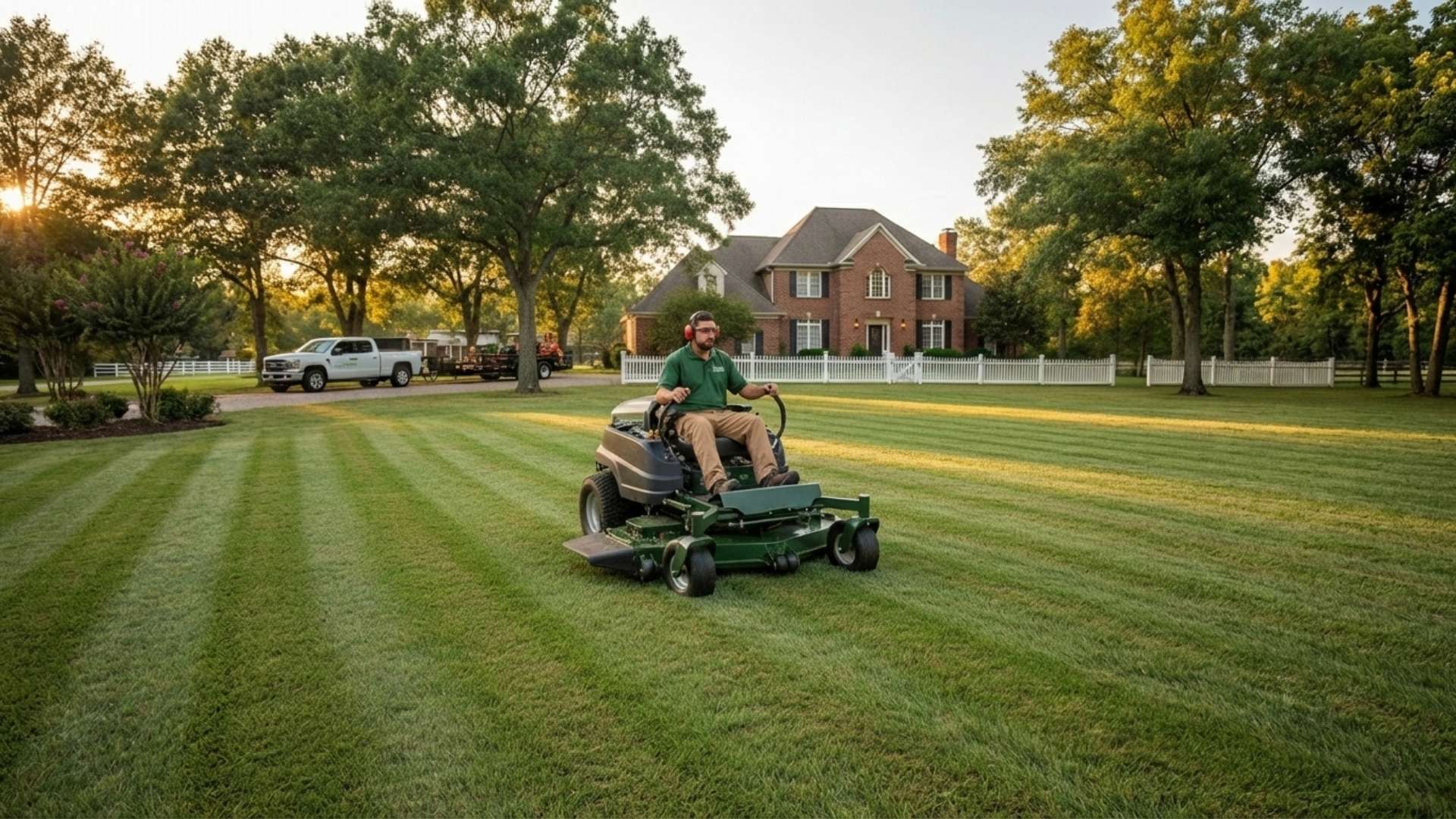
How to Mow a Lawn the Right Way | Expert Guide 2026
Mowing a lawn the right way means never removing more than one-third of the grass blade at once, maintaining sharp mower blades, and cutting at the correct height for your grass species. These three fundamentals prevent stress to the grass plant and promote healthy root development.
At GreenPal, we've connected homeowners with over 45,000 lawn care professionals who've completed millions of mowing jobs. Through this network, we've seen what separates a healthy, thriving lawn from one that struggles. Most homeowners think mowing is just about keeping grass short, but every time you cut grass, you're creating thousands of wounds on living plants. How you make those cuts determines whether your lawn becomes denser and more drought-resistant or thin and vulnerable to weeds.
Why Proper Mowing Matters
Mowing is the most frequent stress you impose on your lawn. Unlike fertilizing or watering, which you do occasionally, mowing happens weekly or even more often during peak growing season.
When you remove leaf tissue, the grass plant redirects energy from root development to shoot regeneration. This metabolic trade-off means improper mowing can actually weaken your lawn's root system, making it less drought-tolerant and more vulnerable to heat stress.
The good news is that grass plants evolved to tolerate regular cutting. They grow from basal meristems located near the soil surface rather than from the tips like most plants. This allows them to regenerate after losing leaf tissue. Your job is to work with this biology rather than against it.
The One-Third Rule: When to Mow Your Lawn
The foundation of proper mowing is the one-third rule: never remove more than one-third of the grass blade height in a single mowing.
This isn't an arbitrary guideline. Research from university extension services shows that removing more than one-third of the leaf tissue causes immediate physiological shock. Root growth can stop for 6 to 12 days while the plant redirects stored carbohydrates to regenerate shoots.
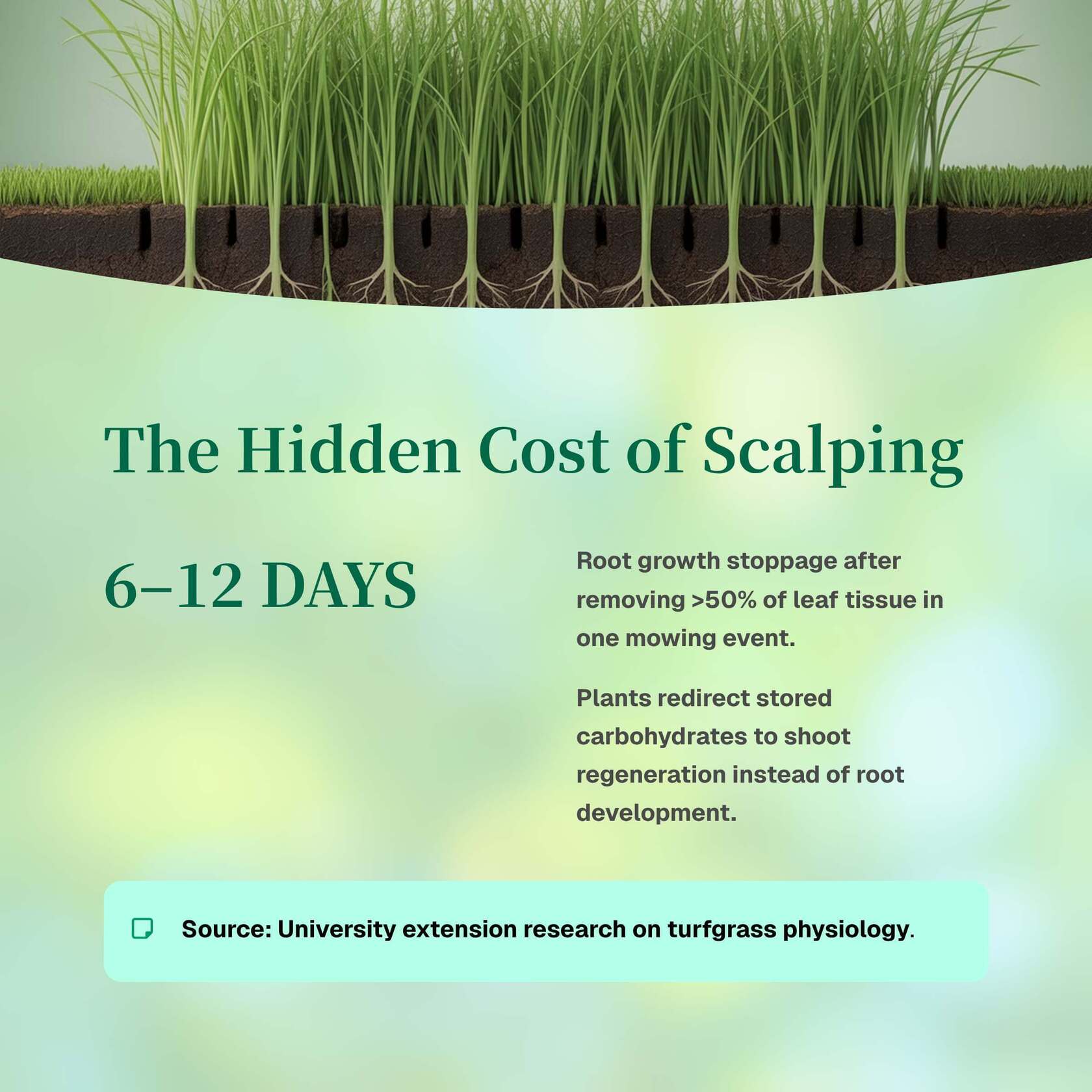
If you repeatedly scalp your lawn, you'll eventually exhaust these reserves.
Calculating When to Mow
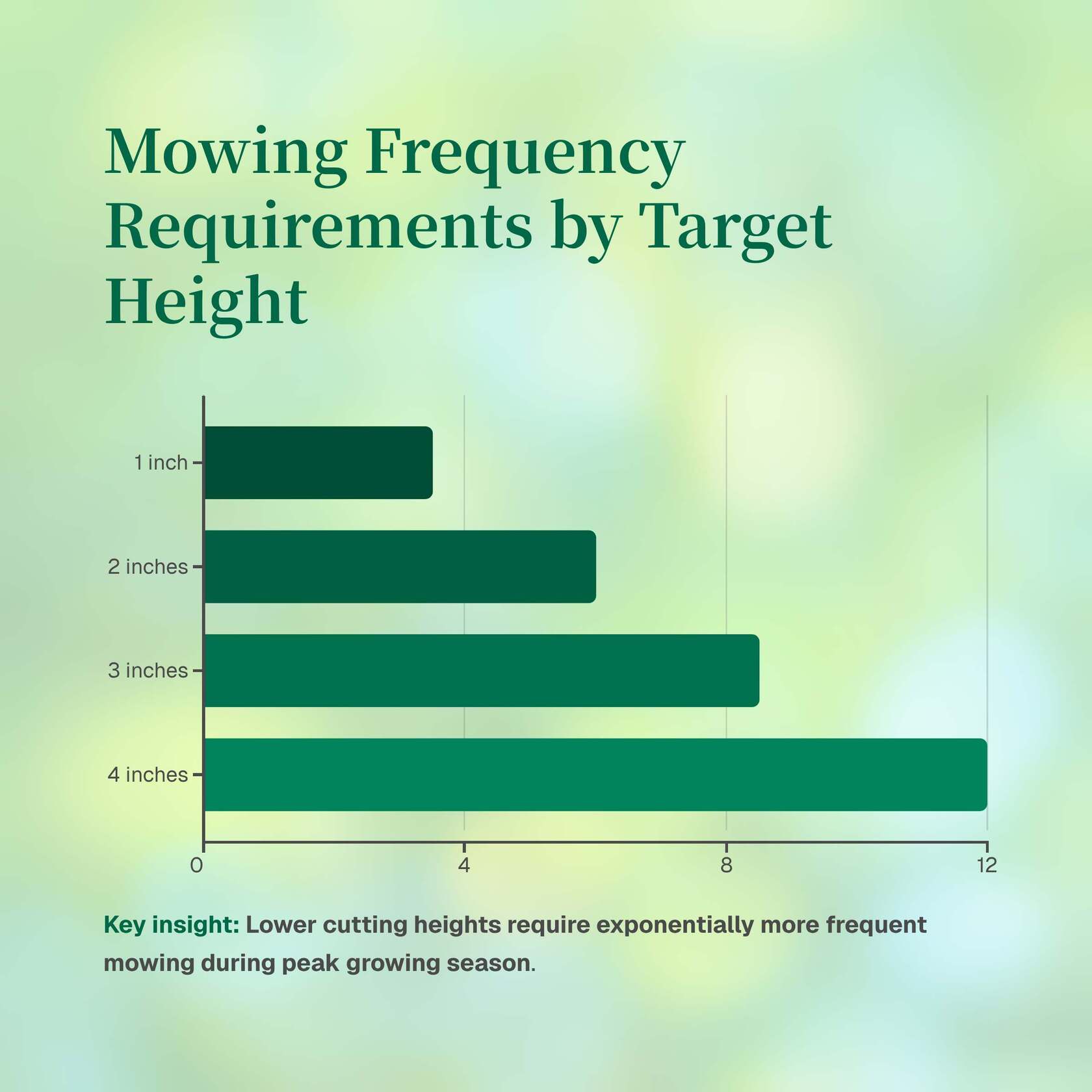
The one-third rule shifts mowing from a calendar-based schedule to a growth-based one. To find your mowing trigger height, multiply your target cutting height by 1.5.
For example:
Target height of 2 inches means mow at 3 inches
Target height of 3 inches means mow at 4.5 inches
During peak growing season, grass can grow half an inch in 48 hours. A lawn maintained at 2 inches needs mowing every 4 to 5 days. A lawn at 3 inches can go 7 to 10 days between cuts.
Desired Height |
Mowing Trigger |
Growth Allowance |
Typical Frequency |
1.0 inch |
1.5 inches |
0.5 inch |
Every 3-4 days |
2.0 inches |
3.0 inches |
1.0 inch |
Every 5-7 days |
3.0 inches |
4.5 inches |
1.5 inches |
Every 7-10 days |
4.0 inches |
6.0 inches |
2.0 inches |
Every 10-14 days |
This explains why maintaining golf course-height turf requires professional daily maintenance. We help homeowners find providers who can accommodate the mowing frequency their desired height requires.
What to Do When Grass Gets Too Tall
Life happens. Rain, vacations, or schedule conflicts mean grass sometimes grows well beyond the trigger height. The temptation is to cut it back to normal height in one pass, but this creates severe stress.
The correct approach is gradual reduction:
Measure the current grass height
Raise your mower deck to remove only the top one-third
Wait 2 to 4 days for recovery
Lower the deck and remove another third
Repeat until you reach your target height
This staged approach prevents the brown, scalped appearance that comes from cutting into stem tissue. It also maintains continuous photosynthesis rather than shocking the plant.
How High Should You Cut Your Grass?
There's no universal correct mowing height. The optimal setting depends entirely on your grass species. If you’re not sure what grass you have, check a recent sod/seed receipt or look up your region’s most common turf types before you set mower height.
Cool-Season Grasses
Cool-season grasses like those found across northern states need taller mowing heights to survive summer heat.
Tall Fescue is the most heat-sensitive. It has a deep root system but cannot tolerate low mowing. Keep it at 2.5 to 3.5 inches, raising to 4 inches during heat waves. Cutting below 2.5 inches exposes the crown to heat stress and reduces stand density.
Kentucky Bluegrass spreads via underground rhizomes, making it more versatile than Fescue. The ideal range is 2.0 to 3.5 inches for residential lawns. You can maintain it lower (1.0 to 1.5 inches) but this requires significantly more water and fertilizer.
Perennial Ryegrass grows in bunches and handles foot traffic well. Maintain it at 2.0 to 3.0 inches. It shreds easily with dull blades, so blade sharpness matters more with Ryegrass than other species.
Warm-Season Grasses
Warm-season grasses evolved in tropical climates and generally tolerate lower heights. Many spread aggressively via stolons (above-ground runners) and benefit from lower mowing to prevent thatch buildup.
Bermudagrass is the gold standard for athletic fields. For quality lawns, maintain it between 0.5 and 1.5 inches. If allowed to grow above 2 inches, green leaves only appear at the tips while stems below turn brown. Subsequent mowing exposes this brown tissue.
Zoysiagrass forms an extremely dense carpet and performs best at 0.5 to 2.0 inches. Its leaves contain high silica content, which dulls mower blades rapidly. Like Bermuda, it accumulates thatch if mowed too high or infrequently.
St. Augustinegrass is the exception among warm-season grasses. It has thick stolons and needs higher mowing at 2.5 to 4.0 inches. Cutting St. Augustine too low removes the canopy that shades its stolons, leading to rapid moisture loss and increased sensitivity to herbicides.
Centipedegrass requires strict adherence to 1.0 to 2.0 inches. Higher mowing promotes excessive stolon growth that doesn't root down, making the turf susceptible to winter kill.
Grass Type |
Optimal Height |
Special Considerations |
Tall Fescue |
2.5-3.5 inches |
Raise to 4 inches in summer heat |
Kentucky Bluegrass |
2.0-3.5 inches |
Can go lower with higher inputs |
Perennial Ryegrass |
2.0-3.0 inches |
Requires sharp blades |
Bermudagrass |
0.5-1.5 inches |
Reel mower recommended below 1 inch |
Zoysiagrass |
0.5-2.0 inches |
Dulls blades quickly |
St. Augustinegrass |
2.5-4.0 inches |
Never scalp this species |
Centipedegrass |
1.0-2.0 inches |
High mowing causes decline |
Adjusting for Environmental Conditions
Standard heights serve as baselines, but conditions require adjustments.
In shade, raise your mowing height to the maximum recommended range. Grass growing in shade is light-limited and elongates leaves to capture more photons. Taller mowing provides more surface area for photosynthesis in low-light conditions.
During summer heat or drought, raise cutting height by 0.5 to 1.0 inch. This creates a deeper insulating layer near the soil surface, keeps the crown cooler, and preserves deeper roots needed to access water.
Choosing the Right Mower for Your Lawn
The mechanics of how your mower cuts grass directly impacts turf health. The two main technologies work on completely different principles.
Rotary Mowers
Rotary mowers dominate residential lawn care. They feature a horizontal blade spinning at 2,800 to 3,200 RPM.
These mowers don't shear grass like scissors. They impact it like a machete, relying on tip speed to sever the leaf blade. The blade's lift wing creates a vacuum that pulls grass upright just before the cutting edge strikes.
Rotary mowers excel with tall grass, seed heads, and rough terrain. They're ideal for turf maintained above 1.5 inches, including Tall Fescue, St. Augustinegrass, and Kentucky Bluegrass.
The trade-off is that cut quality depends strictly on blade sharpness. A dull rotary blade shreds tissue rather than severing it cleanly. The vacuum also makes rotaries prone to scalping on uneven terrain when set below 1.5 inches.
Reel Mowers
Reel mowers use a rotating cylinder with helical blades that pass over a stationary bottom blade. This creates a true shearing action like scissors.
The mechanism produces the cleanest possible cut, sealing the leaf tip instantly and minimizing injury. Reel mowers are essential for maintaining turf at low heights (0.1 to 1.5 inches) where rotaries would scalp. They create the carpet look on Bermudagrass and Zoysiagrass.
The limitation is that reel mowers cannot cut tall grass. If grass is taller than the reel radius, the blades push it over rather than gathering it. This makes the one-third rule critical. Skip a mowing with a reel mower and you'll need a rotary cut to bring height back down.
Reel mowers also require frequent maintenance, including backlapping (spinning the reel backward with grinding compound) to maintain the precise gap between reel and bedknife.
Blade Maintenance: The Key to Healthy Grass
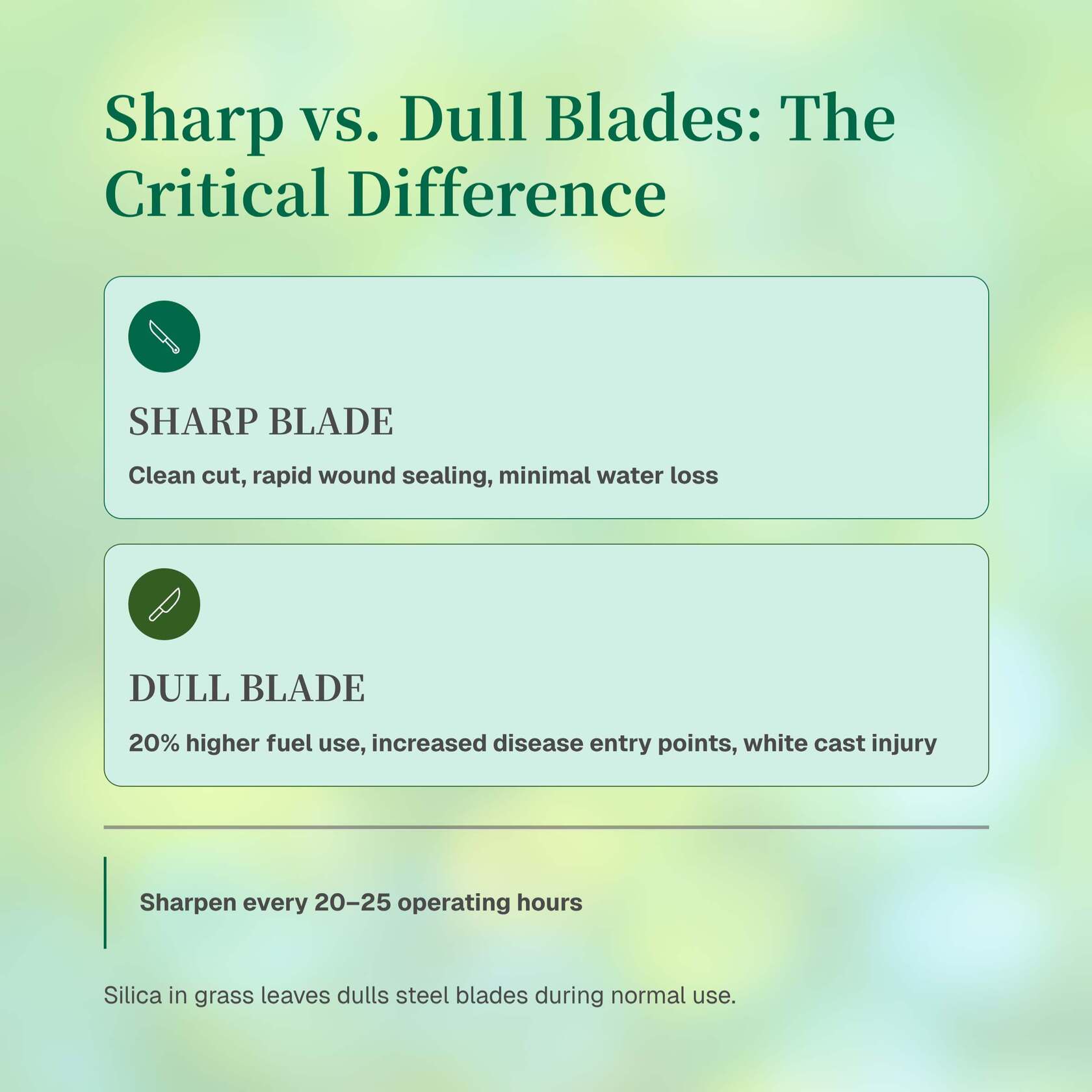
Blade sharpness is the single most critical mechanical variable affecting turf health.
Why Sharp Blades Matter
A sharp blade severs vascular bundles cleanly, allowing the wound to seal rapidly. A dull blade tears and shreds leaf tissue, creating a frayed tip that desiccates and dies.
This mechanical injury appears as a white or gray cast across the lawn. Homeowners often misdiagnose this as disease or drought stress when it's purely equipment-related damage.
The consequences extend beyond aesthetics:
Increased surface area accelerates water loss through evapotranspiration
Jagged wounds provide entry points for fungal pathogens like Brown Patch
Cutting with dull blades requires 20% more fuel and strains the engine
How Often to Sharpen
Grass leaves contain silica, a mineral that's abrasive to steel. Blade sharpness degrades quickly during normal use.
The standard recommendation is sharpening every 20 to 25 hours of operation:
Quarter-acre lawn (30-minute mow): Once per season
Half-acre lawn (60-minute mow): Twice per season
One-acre lawn (2-hour mow): Three to four times per season
Professional turf managers we work with at GreenPal inspect blades daily. Homeowners should check the blade edge after every mowing for nicks from rocks or roots, which need immediate filing to prevent tearing.
Balancing Your Blade
After sharpening, blades must be balanced. Removing more metal from one side than the other creates imbalance. At 3,000 RPM, an unbalanced blade generates severe vibration that causes:
Premature failure of spindle bearings and deck welds
Engine crankshaft damage
Operator fatigue
To balance a blade:
Suspend it by the center hole on a horizontal nail or cone balancer
Gravity pulls the heavier end downward
Remove metal from the heavy end's lift wing (not the cutting edge)
Repeat until the blade hangs perfectly level
Should You Bag or Mulch Grass Clippings?
The fate of grass clippings impacts both soil health and labor efficiency.
The Case for Mulching
Mulching (grasscycling) is the recommended practice for most mowing situations. Mulching mowers recirculate clippings within the deck, chopping them into fine particles that fall deep into the canopy.
Grass clippings are nutrient-dense.
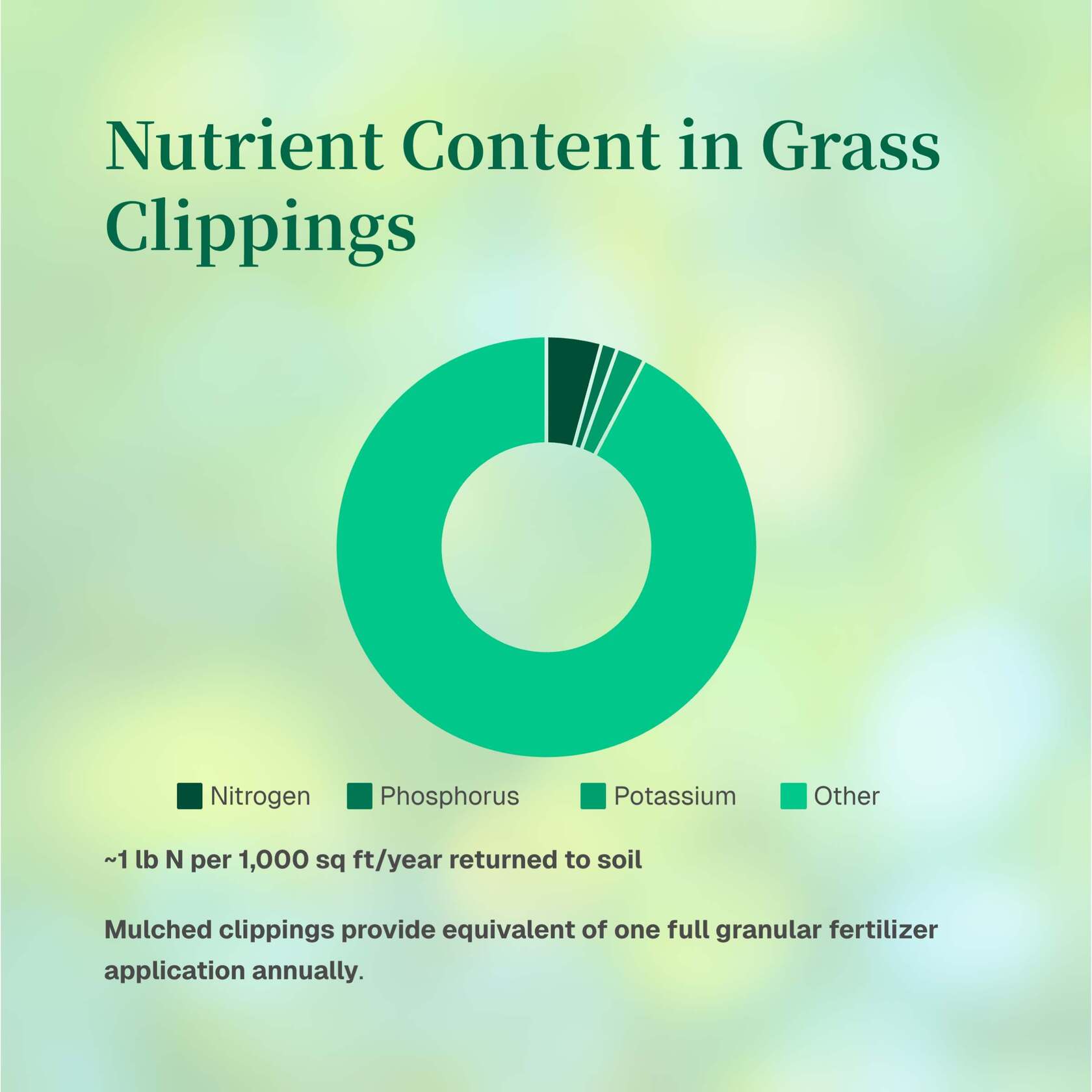
They contain approximately 4% nitrogen, 2% potassium, and 1% phosphorus by weight. Decomposing clippings return about 1 pound of nitrogen per 1,000 square feet per year. This equals one full granular fertilizer application, allowing homeowners to reduce fertilizer inputs by 25 to 30%.
A common misconception is that clippings cause thatch. This is scientifically false. Thatch consists of lignin-rich tissues (roots, rhizomes, stolons) that resist decomposition. Grass clippings are 80 to 90% water with very little lignin. They decompose within weeks and don't contribute to thatch.
When to Bag Clippings
Collection is generally unnecessary and environmentally inefficient. However, specific scenarios require bagging:
Situation |
Reason to Bag |
Active fungal disease |
Prevents dispersing spore-laden tissue to healthy areas |
Heavy weed seed presence |
Removes seeds before they enter soil bank |
Excessive growth (violated 1/3 rule) |
Prevents heavy clumps that shade and kill grass underneath |
If you bag clippings, consider composting them rather than sending them to a landfill. They're valuable organic matter that can return to your landscape in amended form.
Mowing Patterns and Techniques
How you move across your lawn affects both appearance and long-term turf health.
Why Change Directions
Repeatedly mowing in the same direction causes several problems:
Grass develops a grain (permanent lean)
Wheel tracks create soil compaction
Washboarding (ripples in the soil surface)
Rotate your pattern weekly. If you mow north-south one week, go east-west the next, then diagonal the third week. This distributes wear and prevents compaction.
Creating Lawn Stripes
The striped look of professional athletic fields comes from bending grass blades to manipulate light reflection, not from cutting at different heights.
When you mow away from your viewing angle, the rear roller bends grass forward. Sunlight reflects off the broad leaf surface, creating a light appearance. When you mow toward your viewing angle, grass bends toward you. You see leaf tips and shadows, creating a dark appearance.
To maximize striping:
Use a mower with a rear roller or striping kit
Mow at the higher end of your grass species' range (taller grass bends more easily)
Cool-season grasses stripe better than warm-season grasses due to higher water content
For a checkerboard pattern, mow parallel stripes (north-south), then make a second perpendicular pass (east-west). For diamonds, lay diagonal stripes followed by a 90-degree crossing angle.
Trimming and Edging Workflow
Efficient lawn maintenance integrates mowing with string trimming and edging.
The professional approach is trimming first, then mowing. By trimming the perimeter and around obstacles before mowing, clippings from the trimmer land on the lawn. The mower then mulches or bags them, leaving a clean finish without debris on top of cut turf.
When using a string trimmer for edging along concrete, hold the trimmer head vertical to cut a groove. This creates sharp separation between turf and hardscape.
Common Lawn Mowing Mistakes to Avoid
Even experienced homeowners make errors that compromise turf health.
Scalping
Scalping occurs when you cut into stem tissue below the green leaf blades. This exposes brown tissue and removes the plant's ability to photosynthesize. Scalping happens when:
You violate the one-third rule on overgrown grass
Your mower deck is too low for your grass species
You mow over uneven ground with deck set too low
Recovery from severe scalping can take weeks. In extreme cases, you'll kill the grass entirely.
Mowing Wet Grass
Wet grass clumps together and doesn't disperse evenly. Clumps sit on the lawn surface, smothering grass underneath and creating perfect conditions for fungal disease. Wet grass also clogs mower decks and creates slip hazards on slopes.
Wait until grass dries before mowing. Early afternoon is typically ideal, after morning dew evaporates but before evening moisture returns.
Ignoring Blade Condition
Many homeowners mow an entire season without checking blade sharpness. By mid-summer, they're essentially beating grass with a dull metal bar rather than cutting it.
The white cast on grass tips after mowing is your warning sign. Check your blade. If the cutting edge is rounded rather than sharp, it's time to sharpen.
Using the Same Pattern Every Week
This point bears repeating because it's so common. Soil compaction from repeated wheel tracks reduces water infiltration and root penetration. Grass develops a permanent lean that makes achieving a quality appearance difficult.
Through our network, we've seen hundreds of lawns recover simply from implementing pattern rotation.
Lawn Mowing Safety Tips
Mowing involves high-speed rotating blades and heavy machinery. Safety isn't optional.
The 15-Degree Slope Rule
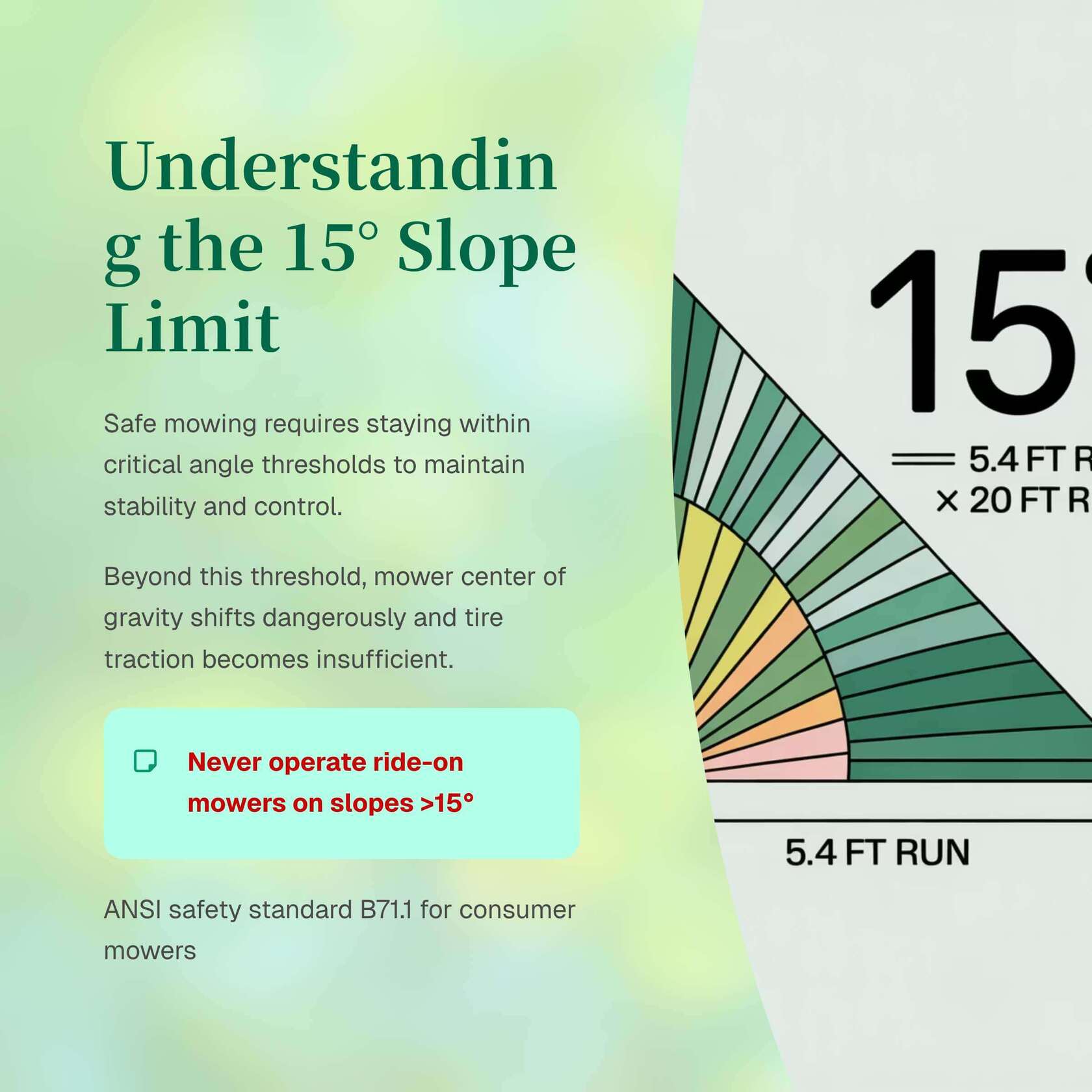
Rollovers cause the majority of deaths and severe injuries involving ride-on mowers. ANSI safety standards set a strict limit: never operate ride-on mowers on slopes greater than 15 degrees.
A 15-degree slope equals a 5.4-foot rise over 20 feet of horizontal distance. Beyond this threshold, the machine's center of gravity shifts dangerously. Friction between tires and turf becomes insufficient to prevent sliding, especially on lush or damp grass.
Zero-turn mowers are particularly dangerous on slopes. Their steering and braking depend entirely on rear drive wheels while front casters roam freely. If pointed downhill, weight transfers to the front casters and rear wheels lose traction, causing uncontrollable slides.
Areas exceeding 15 degrees should be maintained with string trimmers or replanted with low-maintenance groundcovers.
Basic Equipment Safety
Never bypass safety features like blade guards or operator presence controls
Clear the lawn of rocks, sticks, and debris before mowing
Wear closed-toe shoes with good traction
Keep children and pets indoors during mowing
Never add fuel while the engine is hot
Wait for blades to stop completely before making adjustments
Getting Professional Help
Not everyone has the time, equipment, or physical ability to maintain their lawn at optimal standards. That's where professional lawn care services become valuable.
At GreenPal, we've built a marketplace connecting homeowners with local lawn care professionals who understand these principles. Example: if you’re in Austin, start here for quotes: lawn care in Austin, lawn care in Austin, TX. Our platform makes it simple to:
Get quotes from multiple providers in your area
Compare pricing and customer reviews
Schedule one-time or recurring service
Receive photo proof of completed work
If you book ongoing service, this shows you how to adjust dates and frequency: How to Continue or Modify Your Lawn Mowing Service Schedule. How to Continue or Modify Your Lawn Mowing Service Schedule. Over 30% of our users are seniors who appreciate contactless service and the safety of not operating heavy equipment on slopes. Busy professionals value the time savings of not spending weekends behind a mower.
Whether you maintain your own lawn using these techniques or work with a professional, the goal remains the same: a healthy, resilient lawn that looks great and requires fewer inputs over time.
The difference between adequate and excellent lawn care often comes down to understanding these fundamentals. Mowing frequency based on growth rather than calendar, maintaining proper height for your grass species, keeping blades sharp, and working with grass biology rather than against it. These practices transform lawn maintenance from a chore into a system that produces consistently superior results.


