Share
Share


How to Choose the Best Lawn Care Company in Columbus in 2026
The Columbus lawn care market is competitive, and picking the right company takes more than a quick Google search. With labor costs rising, new Ohio licensing rules in effect, and dozens of providers ranging from solo operators to national platforms, the wrong choice can mean wasted money and a patchy yard.
At GreenPal, we connect Columbus homeowners with vetted local lawn care pros every day, so we see what separates a great provider from a mediocre one. This guide breaks down the key factors you should evaluate before hiring anyone in 2026, whether you find them through our platform or on your own.
What Lawn Care Actually Costs in Columbus Right Now
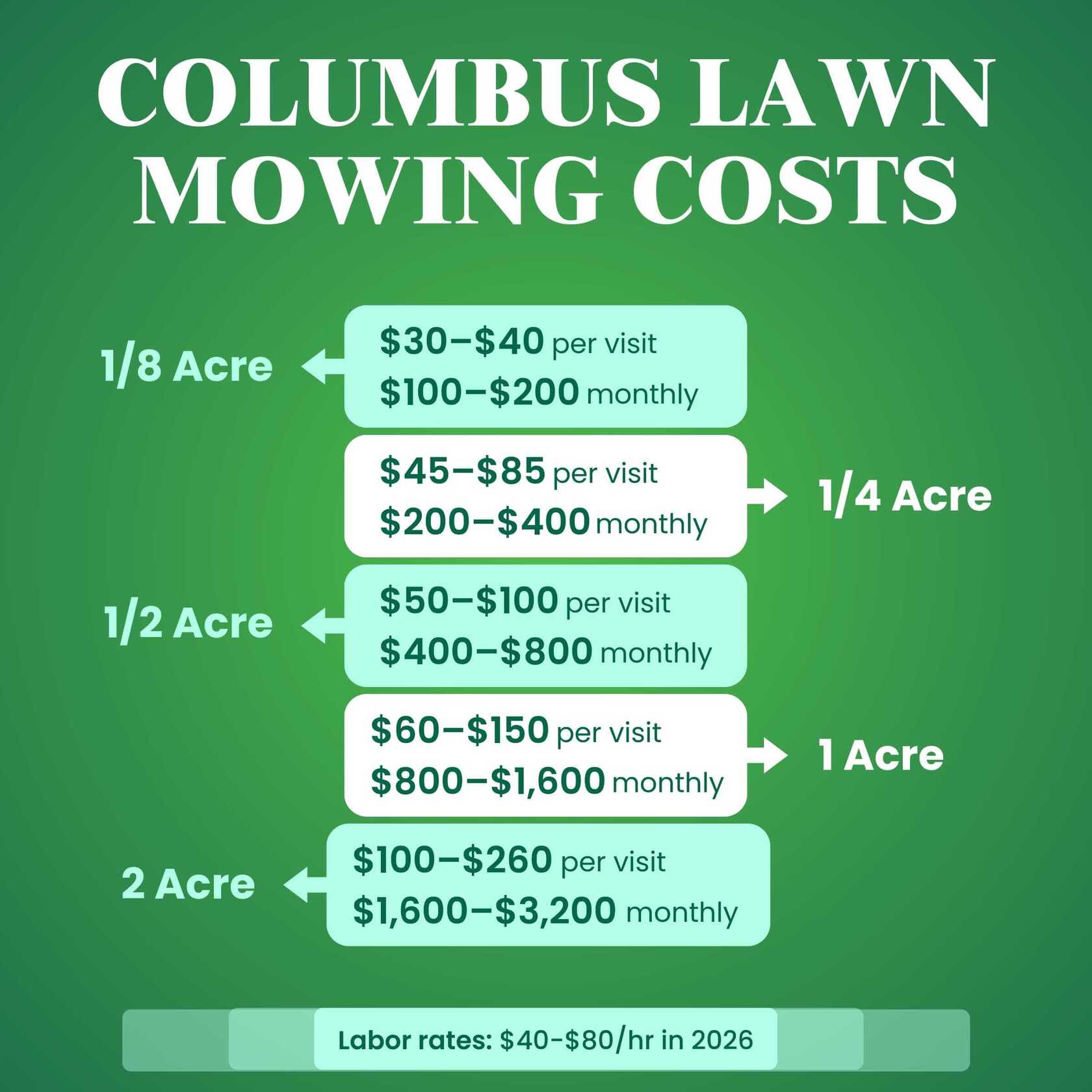
Before you can evaluate whether a quote is fair, you need to know the going rates. Columbus pricing in 2026 is shaped by yard size, service frequency, and the ongoing skilled labor shortage, which has pushed hourly rates to $40-$80 for field technicians.
Here's what Columbus homeowners are paying per mowing visit in 2026:
Yard Size |
Per-Visit Mowing Cost |
Estimated Monthly (Full-Service) |
1/8 Acre |
$30 - $40 |
$100 - $200 |
1/4 Acre |
$45 - $85 |
$200 - $400 |
1/2 Acre |
$50 - $100 |
$400 - $800 |
1 Acre |
$60 - $150 |
$800 - $1,600 |
2 Acres |
$100 - $260 |
$1,600 - $3,200 |
On GreenPal, Columbus mowing prices typically start around $27 to $45 per session for a standard residential lawn. Because multiple providers bid on your job, the competitive pricing tends to land on the lower end of these ranges.
A few things that will push your price higher: overgrown grass (expect roughly double the normal rate if it's over 10 inches), first-time visits where the provider needs extra time to assess the property, and specialty add-ons like aeration or fertilization.
Check for Ohio Licensing and Insurance First
This is the step most homeowners skip, and it's the one that matters most.
Ohio requires any person or business applying pesticides, herbicides, or fungicides to be licensed by the Ohio Department of Agriculture (ODA). If your provider is doing any kind of weed control or lawn treatment beyond basic mowing, they need this license.
A recent update worth knowing about: House Bill 10 now allows non-licensed crew members to apply restricted-use pesticides under the direct supervision of a licensed commercial applicator, as long as they've received additional training. This is good news for smaller operations that struggled to get every employee fully licensed, but it still means someone on the crew must hold the license.
On the insurance side, the ODA mandates specific coverage minimums:
Insurance Category |
Minimum Limit (2026) |
General Aggregate |
$300,000 |
Per Occurrence |
$300,000 |
Products/Completed Operations |
$300,000 |
Workers' compensation insurance is also required for all Ohio landscaping businesses with one or more employees. If you hire an uninsured "independent contractor" and they get injured on your property, you could be held liable.
Ask for proof of both ODA licensing and insurance before any work begins. A legitimate provider will have no problem sharing this documentation.

How to Evaluate a Lawn Care Provider's Quality
Credentials get you in the door. Actual service quality is what keeps your lawn healthy. Here's what to look at beyond the basics.
Look at their track record, not just their pitch
Online reviews are a starting point, but pay attention to patterns rather than individual ratings. A company with hundreds of 4-star reviews and consistent praise for showing up on time is often a better bet than one with a handful of perfect scores and no history.
Review platforms where Columbus homeowners have left thousands of verified lawn care reviews, along with GreenPal's own rating system, give you a way to compare providers side-by-side. On our platform, providers must maintain strong customer ratings to keep receiving jobs, which creates a built-in accountability loop.
Ask about their equipment and approach
The Columbus market is shifting toward electric equipment, partly driven by the city's "Green Spot" sustainability initiative. Providers using all-electric mowers and blowers produce less noise and fewer emissions, which matters if you're in a dense neighborhood like German Village or the Short North.
You don't need to require electric equipment, but it's worth asking what a provider uses. Their answer tells you a lot about how current they are with industry practices.
Find out if they understand Central Ohio conditions
Columbus sits in the Transition Zone for turf management, which means your lawn faces challenges that providers in other climates don't deal with. The soil here is heavy in clay and prone to compaction, which blocks water and nutrients from reaching root systems.
A provider who understands this will recommend fall aeration (ideally a double-pass to penetrate clay soil), suggest appropriate grass species for your specific conditions, and adjust mowing height seasonally. During summer, that means cutting at 3 to 3.5 inches to shade the soil and promote deeper root growth.
If a company offers a one-size-fits-all annual plan without ever asking about your soil or grass type, that's a red flag.
Marketplace Platforms vs. Traditional Lawn Care Companies
Columbus homeowners in 2026 generally have two paths: hire a traditional lawn care company directly, or use a digital marketplace to connect with local providers.
Traditional companies (regional providers like Lawn Doctor, Cardinal Lawns, or ExperiGreen) typically offer structured annual programs with set pricing. You get a dedicated team and a predictable schedule. The trade-off is less flexibility and often higher costs since there's no competitive bidding.
Marketplace platforms work differently. On GreenPal, for example, you enter your address, and local providers compete for your business by submitting quotes. You see each provider's profile, ratings, and pricing before choosing. This competitive bidding model tends to produce lower prices and more transparency, though you're responsible for comparing options rather than having someone assigned to you.
Factor |
Traditional Company |
Marketplace (GreenPal) |
Pricing model |
Fixed annual program |
Competitive bidding per job |
Provider selection |
Assigned to you |
You choose from multiple quotes |
Flexibility |
Contract-based |
No contracts, book as needed |
Cost to homeowner |
Higher (set rates) |
Lower (providers compete) |
Vetting |
Varies by company |
Pre-screened with equipment checks, references, and credit checks |
Scheduling |
Business hours |
24/7 online booking |
Neither model is objectively better. It depends on whether you value structure and consistency (traditional) or flexibility and cost savings (marketplace).
What a Standard Mowing Service Should Include
Regardless of who you hire, a standard mowing visit in Columbus should cover four things:
Mowing the grass to the appropriate height
Weed-eating and trimming around edges, fences, and obstacles
Edging along sidewalks and driveways
Blowing clippings off hard surfaces
Clippings are typically mulched and left on the lawn, which is actually better for soil health than bagging. If a provider charges extra for these basics or doesn't include edging, keep looking.
Services like fertilization, weed control, aeration, and overseeding are usually separate. Many mowing providers offer them as add-ons, but these treatments often require the ODA licensing mentioned earlier. On GreenPal, homeowners frequently arrange these additional services directly with their chosen provider once they've built a working relationship through regular mowing.
The Seasonal Calendar Every Columbus Homeowner Should Know
Timing matters as much as technique in Central Ohio. Here's when each major service should happen:
Spring (March through May): Apply pre-emergent herbicides before crabgrass germinates. This happens when soil temperature reaches about 55°F. Light fertilization helps wake the lawn from winter dormancy.
Summer (June through August): Mow high (3 to 3.5 inches minimum) and focus on grub control. Grub treatments are most effective when applied just before or after early summer hatching.
Fall (September through November): This is the most important window for Columbus lawns. Aeration, overseeding, and heavy fertilization all happen now to repair summer heat damage and store energy for winter. If you only invest in one season of professional care, make it fall.
Winter (December through February): Winterize irrigation systems to prevent pipe bursts and plan for snow and ice management. If your provider offers snow removal, this is when to set that up.
A good provider will proactively suggest services aligned with this calendar rather than waiting for you to ask.
Red Flags to Watch For
After years of working with lawn care providers across 250+ markets, we've seen the patterns that signal trouble. Watch out for:
No photo documentation. In 2026, sending photos of completed work is standard practice. If a provider doesn't offer this, they're behind the curve. GreenPal requires photo proof before payment is processed, and we've found it eliminates most disputes before they start.
Rock-bottom introductory pricing. A "$19 first mow" deal sounds great until week three when the real price kicks in. Consistent, market-rate pricing from day one is a better indicator of a company that plans to stick around.
No clear answer on insurance or licensing. Hesitation here is disqualifying. Move on.
Inability to explain their approach. If a technician can't tell you why they're recommending a particular treatment or what grass type you have, they're likely following a generic script.
High-pressure contract tactics. You shouldn't need to sign a long-term contract to get your lawn mowed. Platforms like GreenPal operate on a no-commitment basis precisely because locking people in doesn't lead to great service.
How to Get Started Without Overpaying
The simplest way to benchmark lawn care pricing in your specific Columbus neighborhood is to get multiple quotes. Whether you call three local companies or use a platform that collects bids for you, comparison is the fastest path to a fair price.
On GreenPal, the process takes about 60 seconds. Enter your Columbus address, and you'll typically receive up to five quotes within minutes from pre-vetted local providers. You can compare pricing, read reviews, and book service without a phone call. There's no cost to get quotes and no obligation to accept any of them.
If you prefer a more traditional route, look for providers with strong presence in Columbus-specific directories, solid BBB ratings, or recognition in local awards like the CBUS Top Picks Community's Choice Awards.
Whatever path you choose, the fundamentals are the same: verify licensing and insurance, compare at least three quotes, ask about their approach to Central Ohio's clay soil and seasonal needs, and don't pay for service until the work is confirmed complete.
Your lawn is one of the first things people notice about your property. Choosing the right partner to maintain it is worth getting right.
Ready to see what lawn care pros in Columbus are charging? Get free quotes on GreenPal and compare vetted local providers in minutes.