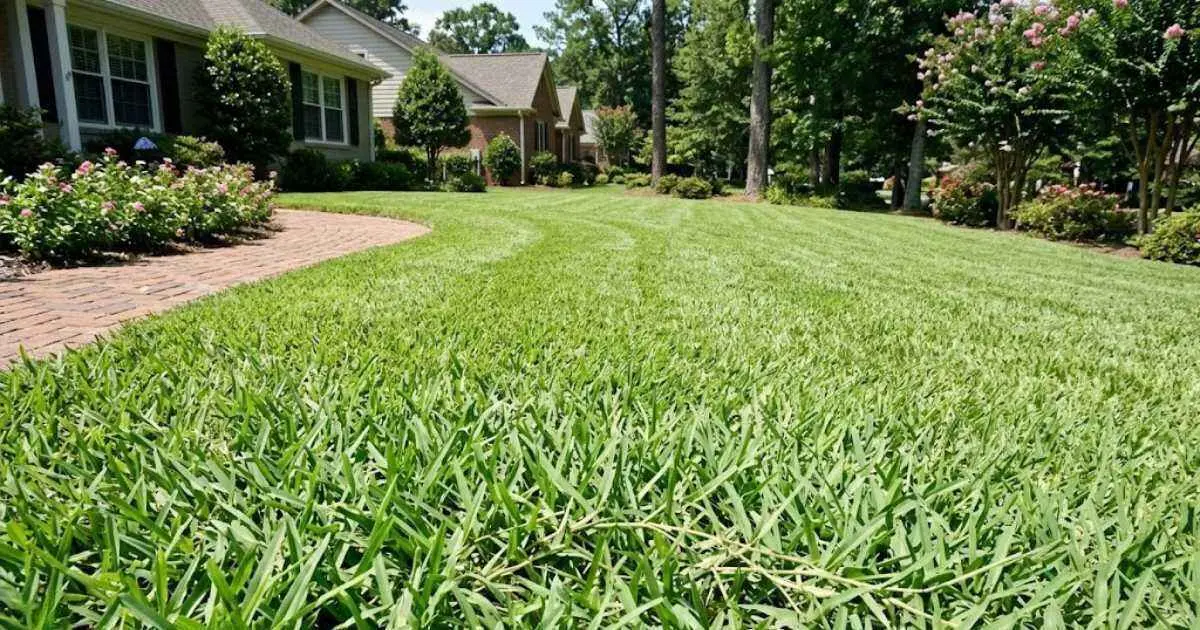
Centipedegrass Lawn Care Calendar
Centipedegrass earns its famous nickname "lazy man's grass" with its slow growth and low fertilizer needs. But it's a sensitive warm-season grass that won't tolerate poor soil health, heavy shade, or overfertilizing. In this lawn care calendar, we’ll show you how to maintain centipedegrass month by month so your lawn stays healthy with minimal effort.
▲ marks the best time to perform the designated task.*
△ marks an acceptable time to perform the designated task.*
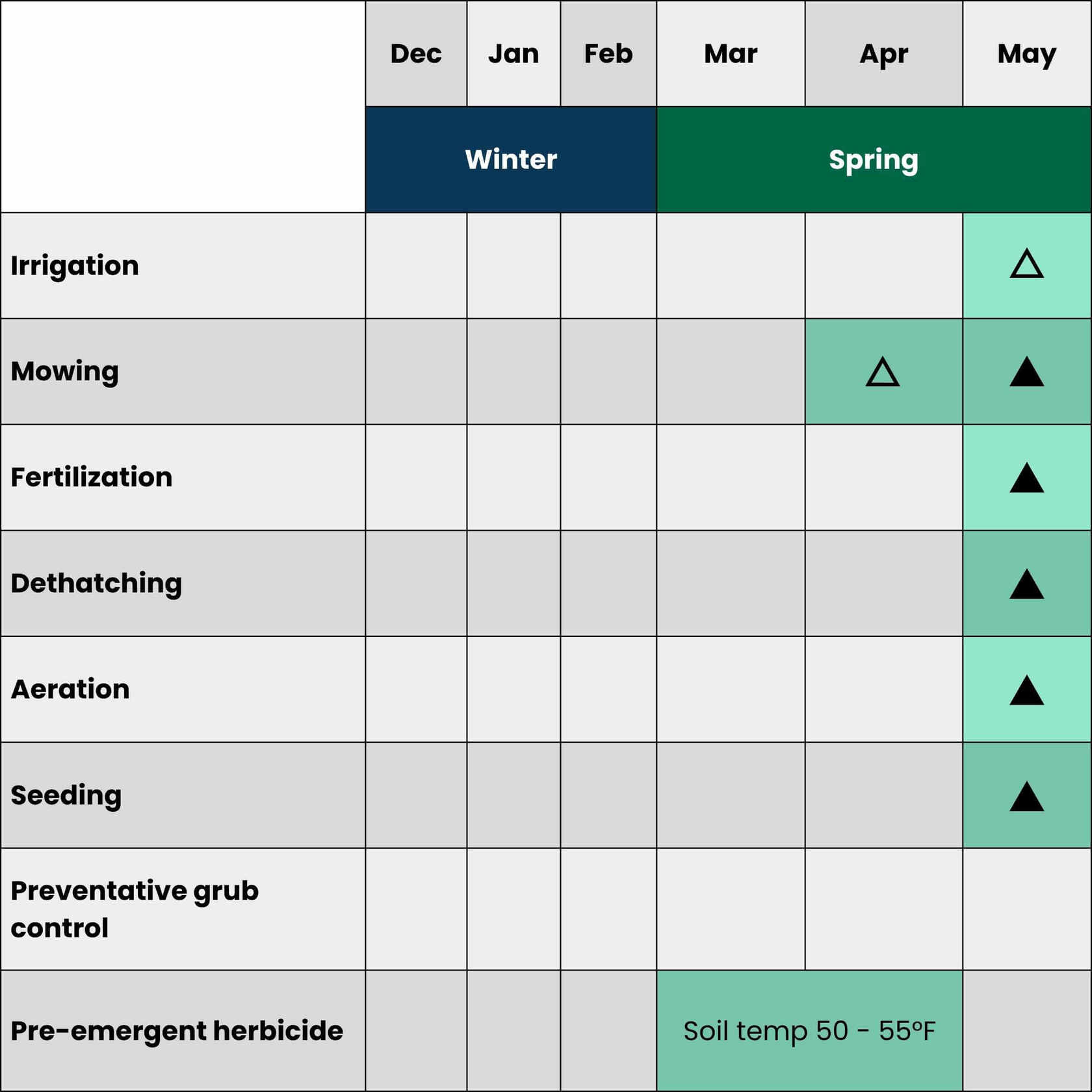
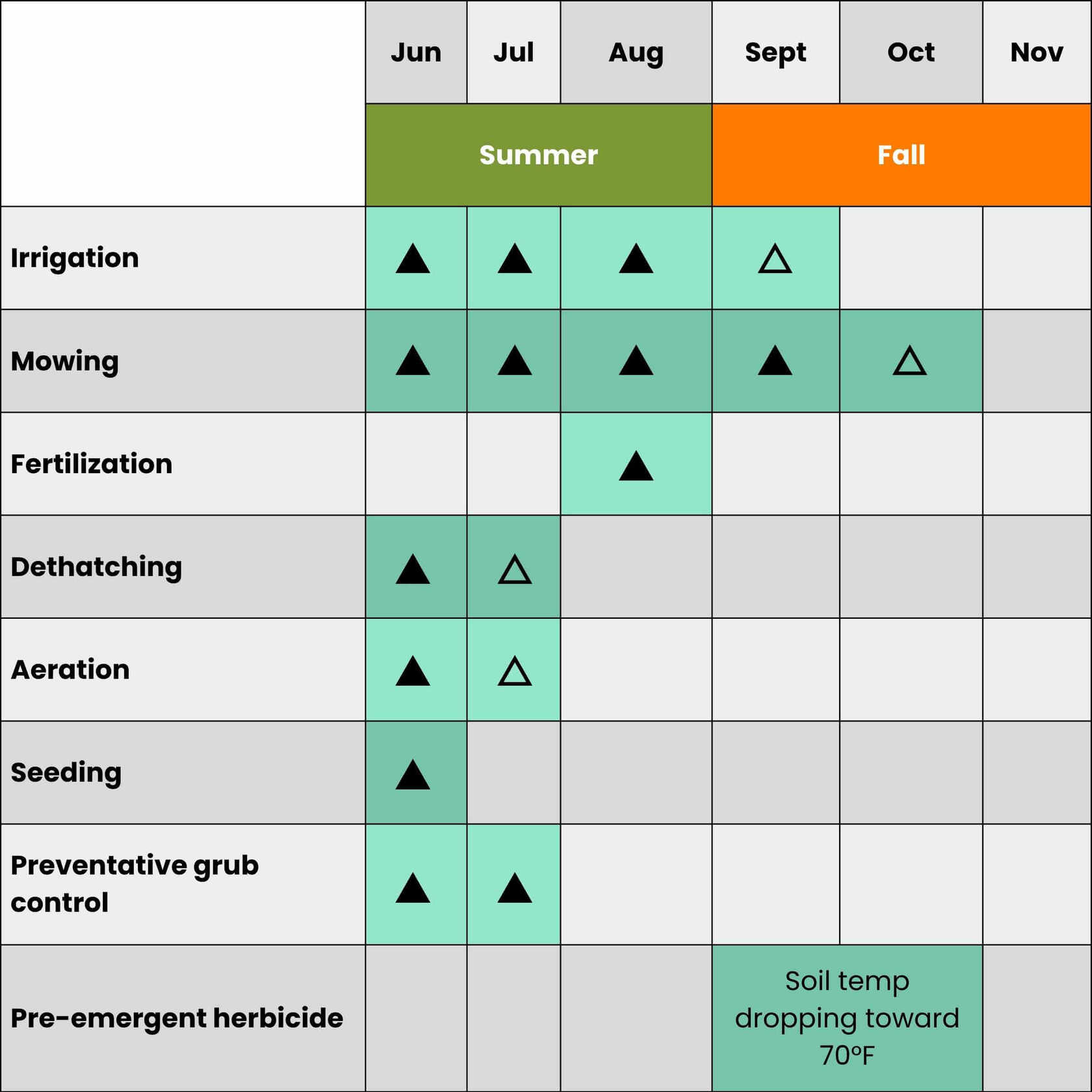
*Timing will vary up to 3 or more weeks by location, and this maintenance calendar represents a general range for centipedegrass lawns across southern and transition-zone regions. Location, forecasted frost dates, soil conditions, age of lawn, and several other factors can affect maintenance timing.
Spring: March, April, May
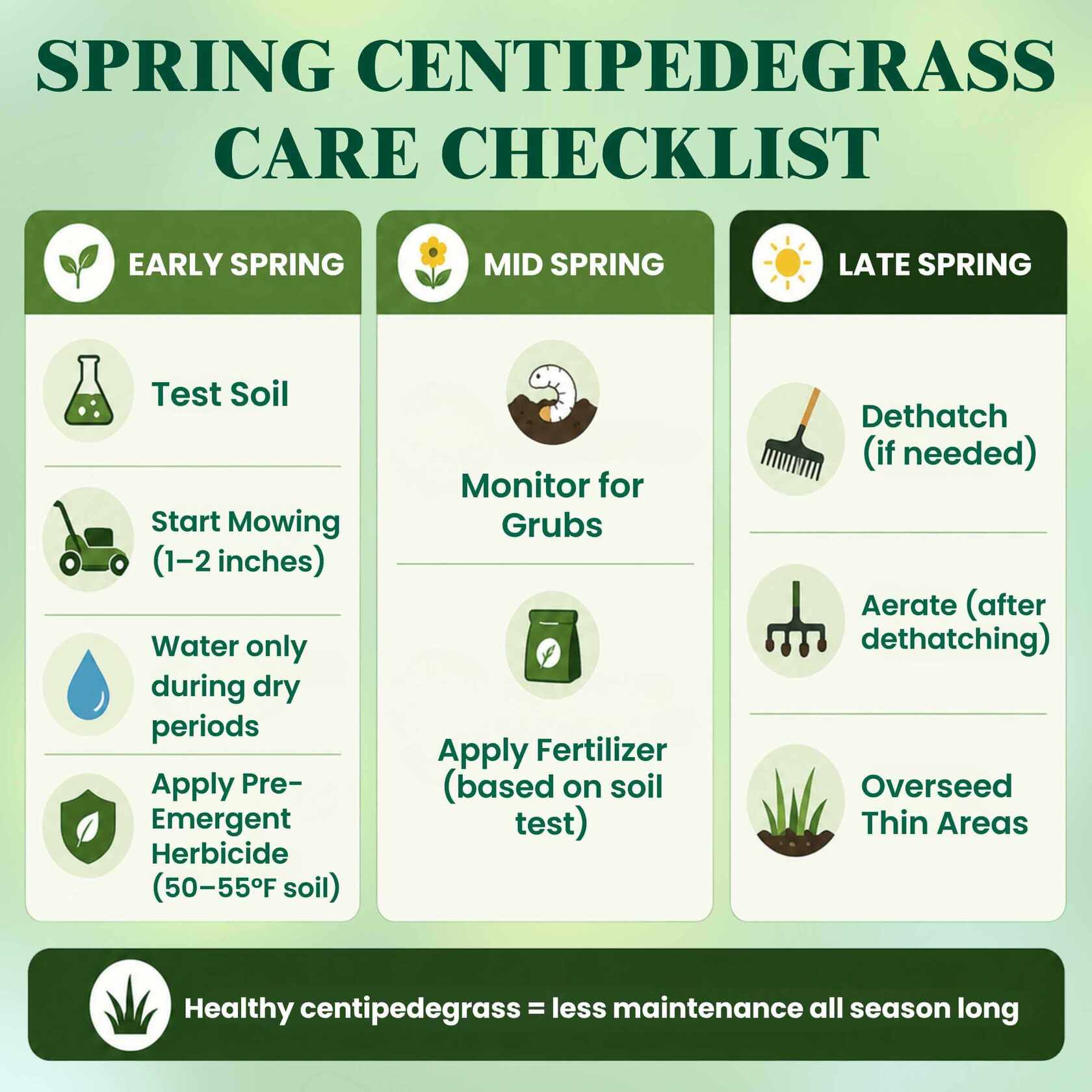
As temperatures start to warm, centipedegrass exits winter dormancy, returns to its apple-green color, and requires occasional mowing. It won’t need aeration, dethatching, and fertilization until May.
If you didn’t test your soil in fall, send a soil sample to your local cooperative extension in early spring to determine what fertilizer and amendments your soil needs this season, if any.
Mowing
Begin mowing when the grass turns green in the spring. Centipedegrass prefers a mowing height between 1 and 2 inches tall.
Mow as often as needed to avoid removing more than one-third of the grass blade’s height in a single mow, which is harmful to turf.
Tip: Give your lawn a head start with professional spring cleanup to remove winter debris, redefine edges, and perform the first mow of the season.
Irrigation
Spring rainfall usually gives lawns all the water they need.
During dry periods, be on the lookout for common signs your lawn needs water — such as curling or wilting leaf blades, lingering footprints, or a bluish gray color — and provide supplemental irrigation as needed.
Weed Control
Due to centipedegrass’ slow growth rate and germination, weeds can easily invade newly established lawns. If your lawn is still young or has a recent history of weed problems, consider applying a pre-emergent herbicide to block summer weeds.
Apply pre-emergent herbicide in early to mid-spring when soil temperatures are consistently between 50 and 55°F.
Tips:
Centipedegrass is sensitive to some herbicides, so always read the product label to ensure the ingredients are safe for your lawn.
Water in the herbicide immediately after application to activate its chemical barrier.
Most pre-emergent herbicides require waiting 8 to 12 weeks or longer before planting new grass seed.
Aeration and dethatching can break down the chemical barrier. Delay these invasive treatments until the product's labeled wait time has passed, but perform them no later than early summer.
Learn More: When to Apply Pre-Emergent Herbicide
Monitor for Grubs
White grubs are a common pest affecting lawns throughout the United States. Monitor your lawn for spring grub activity, such as brown patches in the lawn, turfgrass lifting up like carpet, or C-shaped larvae residing in the soil.
If your lawn has a severe grub infestation in spring, this may warrant applying preventative insecticides in summer.
Learn More: How to Get Rid of Lawn Grubs
Fertilizer & Soil Amendments
Always base fertilizer applications on a soil test. This is especially important for centipedegrass, which is sensitive to high phosphorus and low potassium levels. Generally, centipedegrass benefits from 1 pound of nitrogen per 1,000 square feet around mid-May.
Centipedegrass prefers acidic soil with a pH between 5.0 and 6.0, so lime is rarely needed. That low soil pH preference, however, makes it prone to iron deficiencies and iron chlorosis, so a soil test may recommend chelated iron. If the soil has a high pH, sulfur may be needed to bring it down.
Learn More: How to Fertilize Your Lawn
Thatch Removal
The best time to remove thatch from your warm-season lawn is late spring through early summer.
Thatch is the layer of dead and living organic material that collects between the grass blades and soil surface. A thick thatch layer blocks water, nutrients, and oxygen from penetrating the soil, affecting the lawn’s overall health.
Remove thatch once the layer exceeds one-half inch thick, usually every 2 to 5 years. If you are aerating and dethatching in the same year, dethatch before you aerate.
Learn More: Why, When, and How to Dethatch Your Lawn
Aeration
Core aeration is the process of relieving soil compaction in the lawn by removing plugs of soil from the ground. If the lawn’s soil is hard and compacted, aerate in late spring or early summer.
Sandy soils are less susceptible to soil compaction than clay soils. Sandy soils usually require aeration once every 1 to 3 years, while clay soils benefit from annual aeration.
If you are aerating and dethatching in the same year, aerate after you dethatch.
Learn More: Why, When, and How to Aerate Your Lawn
Overseeding
If your centipedegrass suffered from winter injury or is thinning, apply new grass seed over the existing lawn and bare areas. Keep in mind that centipedegrass can take up to three years to fully establish.
Tips:
Aerating before overseeding increases seed-to-soil contact.
Avoid overseeding and applying pre-emergent herbicide too close together. Most pre-emergent herbicides require waiting 8 to 12 weeks or longer before planting new grass seed.
Avoid a heavy nitrogen fertilizer for approximately 4 to 6 weeks, as nitrogen may cause existing grass to outcompete young grass.
Summer: June, July, August
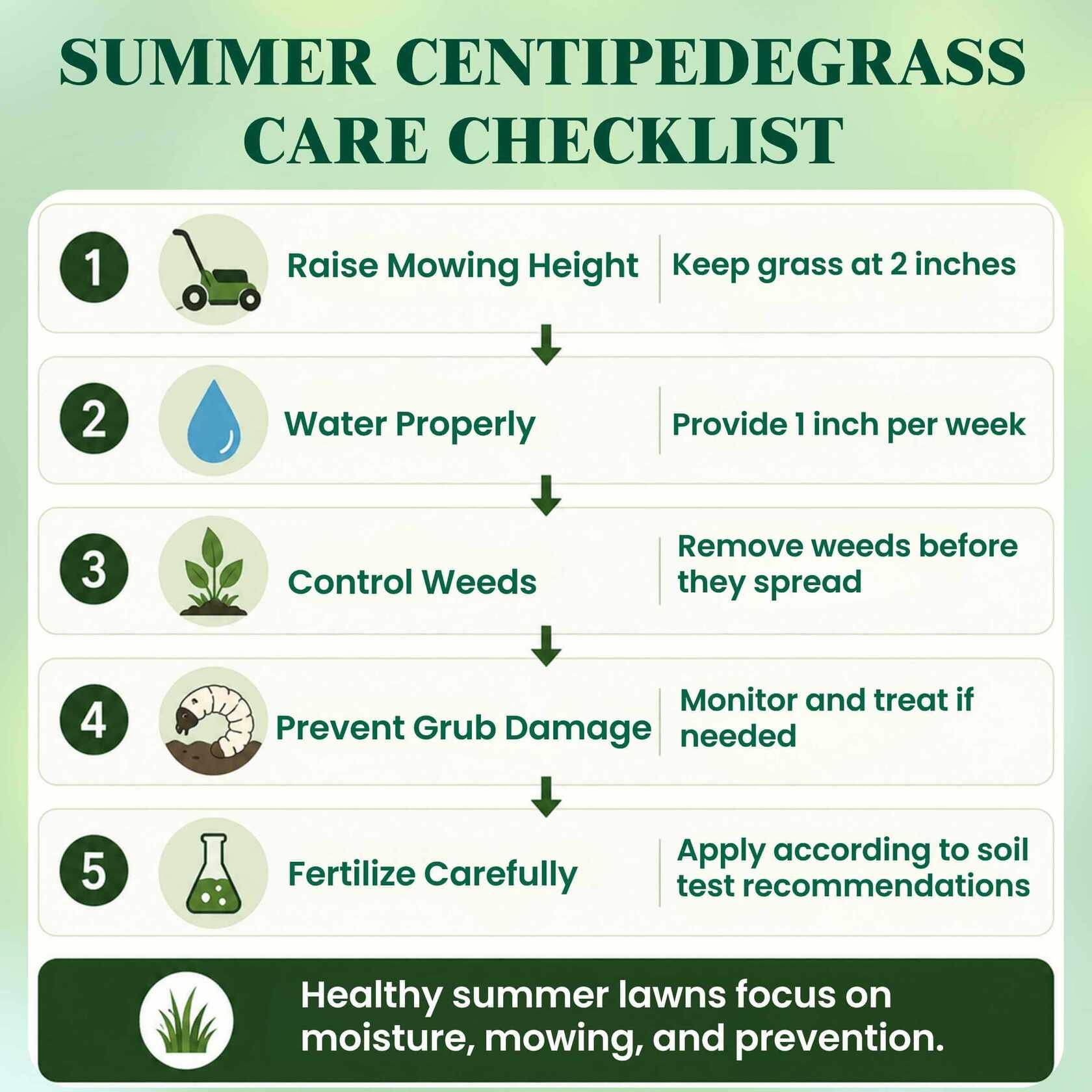
With warmer temperatures comes faster growth, so prepare to mow slightly more often in summer.
If you missed the late spring window for dethatching, aeration, or overseeding, wrap up those chores in early summer.
Raise Mowing Height
Raise the mowing height to 2 inches tall if you’re not mowing at that height already. Tall grass helps the lawn retain moisture and resist heat stress by shading the soil and cooling the roots.
Always practice good mowing habits to protect the health of your lawn, such as mowing with sharp blades, not removing too much at once, and never mowing wet grass.
Learn More:
Irrigation
Centipedegrass requires 1 inch of water per week to remain healthy.
If your lawn has clay soil (which absorbs water slowly) apply the water in two parts to help prevent runoff. Apply 0.5 inch of water, wait about an hour, then apply another 0.5 inch.
If your lawn has sandy soil (which does not retain moisture as well as clay or loamy soil), irrigate two to three times per week to reach the recommended 1 inch of total weekly water.
Learn More: How to Water Your Lawn: Tips & Schedule
Weed Control
If weeds pop up in summer, you can remove them via post-emergent herbicides, hand pulling, digging, weeding tools, or homemade weed killer.
Remember that centipedegrass is sensitive to some herbicides (such as 2,4-D), so be careful and follow label directions.
Learn More:
Grub Control
If your lawn has a recent history of severe grub activity, apply preventative insecticides in June or July, before the eggs hatch in mid-to-late July.
Grubs are common throughout the United States, even infesting lawns from the cooler climate of Rochester, NY to the warmest parts of Tampa, FL. If your lawn is suffering from grub damage, consider hiring a local lawn care professional who can nurse your grass back to health.
Fertilization
As mentioned before, always base your fertilizer regimen on the results of a soil test.
An established centipedegrass lawn may benefit from 0.5 to 1 pound of nitrogen per 1,000 square feet in late summer.
Note: Do not apply more than 2 pounds of nitrogen per 1,000 square feet per year on centipedegrass.
Fall: September, October, November
As the summer growing season comes to a close and centipedegrass slows down, so do your lawn chores.
Test Soil
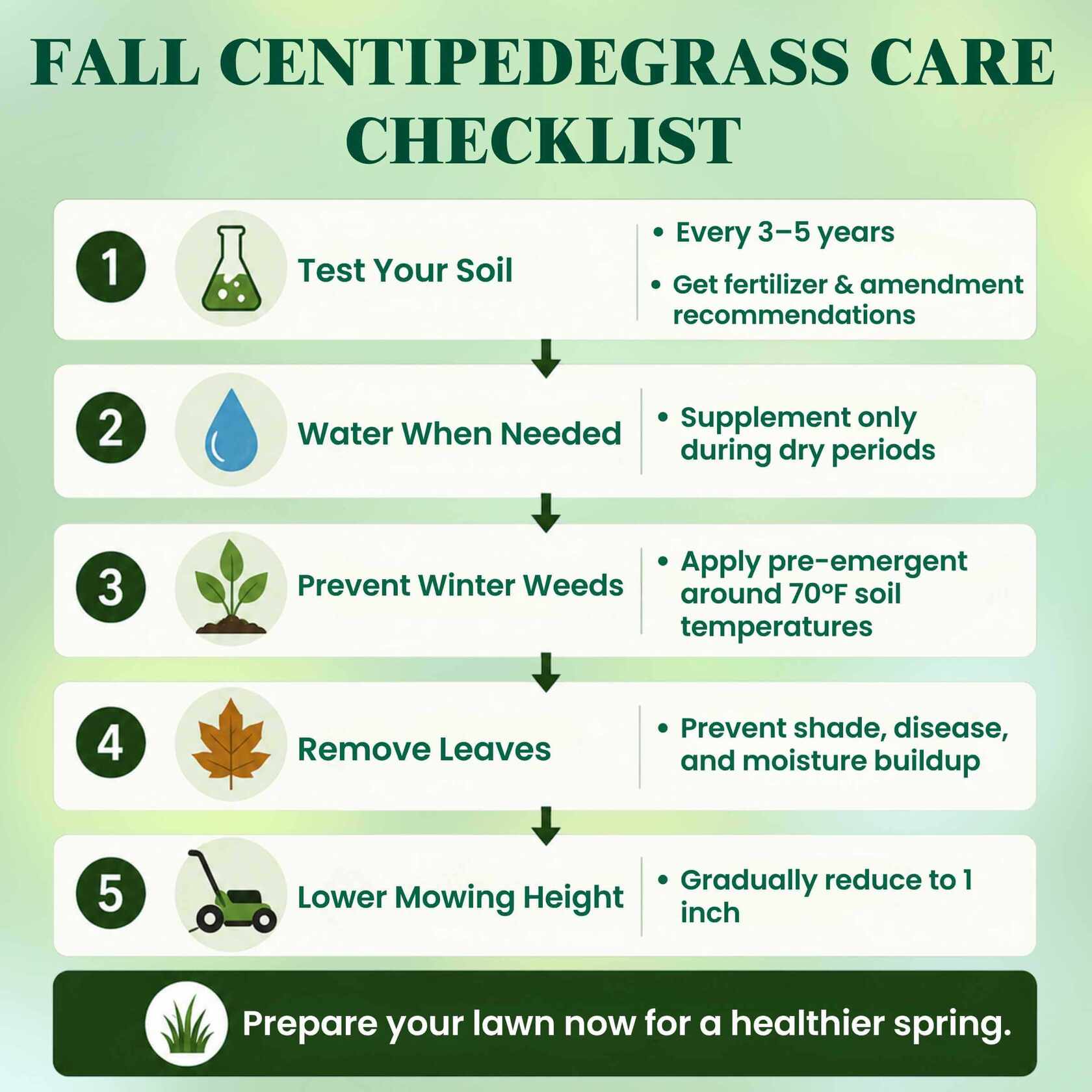
Early fall is an excellent time to test your soil. While DIY soil kits are available for purchase, they typically don’t provide actionable fertilizer recommendations specific to your lawn.
Instead, send a soil sample to your local cooperative extension service for laboratory testing to receive detailed instructions on how to amend and fertilize your soil.
It’s good practice to test your soil every 3 to 5 years. If you’re amending the soil and need to monitor its progress, test approximately once per year.
Irrigation
Like spring, fall usually provides enough precipitation for the lawn. Provide supplemental irrigation when your lawn shows signs of thirst.
Weed Control
If your lawn has frequent battles with dandelions or winter weeds, apply pre-emergent herbicide in early fall when the soil temperature drops and approaches 70°F.
Remove Leaves
It may be tempting to procrastinate leaf raking duties, but it’s important to remove fallen leaves from your lawn. A thick layer of leaves blocks sunlight, prevents photosynthesis, and suffocates the grass. And a wet layer of leaves after rainfall can spread fungal diseases and pests to the lawn.
Raking is a laborious task. If you’d rather be carving pumpkins than raking leaves, consider scheduling professional leaf removal.
Lower Mowing Height
Gradually lower the mowing height down to 1 inch over several mows. Short grass is less susceptible to winter injury, snow molds, and matting than tall grass.
Winter: December, January, February
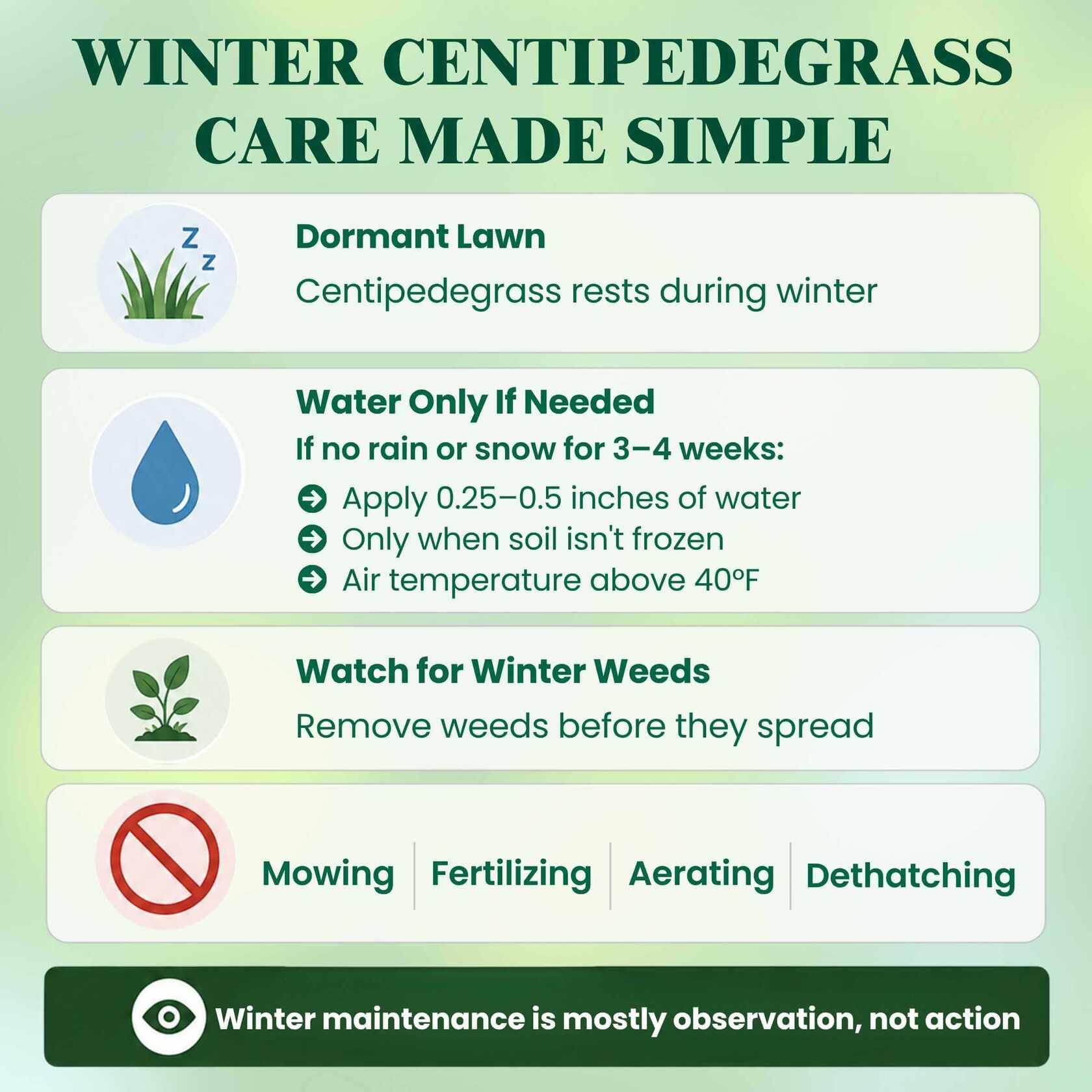
Winter lawn maintenance is a breeze. Put away your lawn mower, don’t touch the fertilizer, and monitor your lawn for winter weeds and drought stress.
Rain and snow usually provide warm-season grasses with enough moisture in winter. However, if there hasn’t been precipitation in 3 to 4 weeks, apply 0.25 to 0.5 inches of water when the soil is not frozen and air temperatures are above 40°F.
Frequently Asked Questions About Centipedegrass
What Is Centipedegrass Decline?
Stressful environmental or maintenance conditions can cause "centipedegrass decline,” which is when centipedegrass fails to green-up in spring or successful green-up is followed by decline and death in late spring or summer.
What Pests Infest Centipedegrass?
Centipedegrass is susceptible to several pests, including:
White grubs
Mole crickets
Nematodes
Spittlebugs
Ground pearls
How Much Fertilizer Does Centipedegrass Need?
Centipedegrass doesn’t need much fertilizer, and over-fertilization is a significant cause of its decline. Do not apply more than 2 pounds of nitrogen per 1,000 square feet per year.
Always base fertilizer applications on the results of a soil test. Generally, centipedegrass lawns benefit from 1 pound of nitrogen per 1,000 square feet in late spring and a second application of 0.5 to 1 pound of nitrogen per 1,000 square feet in late summer.
Find a Lawn Care Pro Near You
Remember, centipedegrass is a low-maintenance, slow-growing turfgrass that declines when over-fertilized or over-watered. Less is more. If you're unsure how to manage centipedegrass' sensitivities, consider hiring a local lawn care professional familiar with the grass.